
Flying with camping gear sounds, at first glance, like one of those things that should be fairly straightforward.
You put your stuff in a bag, you take it to the airport, and off you go. People fly with skis, golf clubs, and occasionally what looks like a medium-sized canoe, so a tent and a sleeping bag shouldn’t really cause much concern.
And yet, the moment you actually start packing, things begin to feel… less certain.
You find yourself holding a camping stove and wondering if it counts as “potentially explosive”. You stare at a gas canister like it might suddenly confess to being illegal. And you briefly consider whether a tent peg could be interpreted as a weapon. Before long, what started as a simple packing job turns into a quiet negotiation with airport security that you’re conducting entirely in your own head.
This is where most people get stuck.
Not because flying with camping gear is especially complicated, but because it sits in that awkward middle ground between “completely fine” and “absolutely not allowed”, depending entirely on what you’re bringing and how you pack it.
The good news is, once you understand a few key rules, it becomes surprisingly manageable.
You can take most camping gear on a plane, including tents, sleeping bags, clothing, and backpacks. However, items like knives, tent pegs, and hiking poles usually need to go in checked luggage, while fuel (such as gas canisters or liquid fuel) is not allowed at all. The key is knowing what’s permitted, what needs to be packed carefully, and what’s better to leave behind or buy at your destination.
The even better news is, you don’t need to bring everything. In fact, if you’ve ever gone down the rabbit hole of lightweight camping, you’ll already know that taking less tends to make most camping trips better, not worse, especially when airports are involved.
So rather than trying to take your entire outdoor life with you, the goal here is much simpler.
Let’s get into the details…
Contents
- Can You Take Camping Gear on a Plane?
- What You Can and Can’t Bring (Without Causing a Scene at Security)
- Carry-On vs Checked Luggage (What Goes Where)
- How to Pack Camping Gear for Air Travel
- Airport & Security Tips (What Actually Happens on the Day)
- International Travel Differences (Why It’s Not Always Exactly the Same)
- Frequently Asked Questions
- Final Thoughts
Can You Take Camping Gear on a Plane?
Once you move past the initial “is this allowed?” stage, the whole thing becomes less about permission and more about how your gear is interpreted when it goes through the system.
Because at the airport, no one is looking at your bag thinking, “Ah yes, a well-considered three-season camping setup.”
They’re looking at shapes on a screen.
And those shapes fall, broadly speaking, into three categories.
There’s the soft, unremarkable stuff – clothing, sleeping bags, tents – the kind of gear that doesn’t really register as anything unusual. This is the easiest part of the process. It goes through, it gets loaded, and no one gives it a second thought.
Then there’s the slightly more questionable category.
Things that aren’t dangerous in any meaningful sense, but could look a bit… ambiguous. Tent pegs, poles, compact tools, bits of metal that don’t immediately explain themselves. These aren’t a problem, but they do tend to be treated more cautiously, which is why they’re better off in checked luggage where they don’t invite unnecessary attention.
And then there’s the category that causes most of the confusion.
Anything that looks like it might involve fuel, pressure, or heat.
This is where the line becomes much firmer. Not because airlines are being particularly difficult, but because once something could ignite, leak, or behave unpredictably at altitude, the answer tends to shift very quickly from “probably fine” to “definitely not coming with you”.
This is also why two people can have completely different experiences flying with what looks, on the surface, like very similar gear.
One packs simply, keeps things clean, avoids anything that raises questions, and gets through without a hitch. The other throws everything in a bag, including items that sit right on the edge of what’s allowed, and ends up having a slightly longer conversation at security than they were planning for.
So while the short answer is still “yes, you can take camping gear on a plane”, the more accurate version is that you can take most of it, as long as you understand which parts are completely straightforward, which ones need a bit of thought, and which ones are better left behind entirely.
And that’s where things start to get a bit more specific…
What You Can and Can’t Bring (Without Causing a Scene at Security)
Once you start looking at individual items, things become a lot clearer.
Not necessarily more complicated, just easier to sort into what’s completely fine, what needs a bit of thought, and what simply isn’t worth attempting.
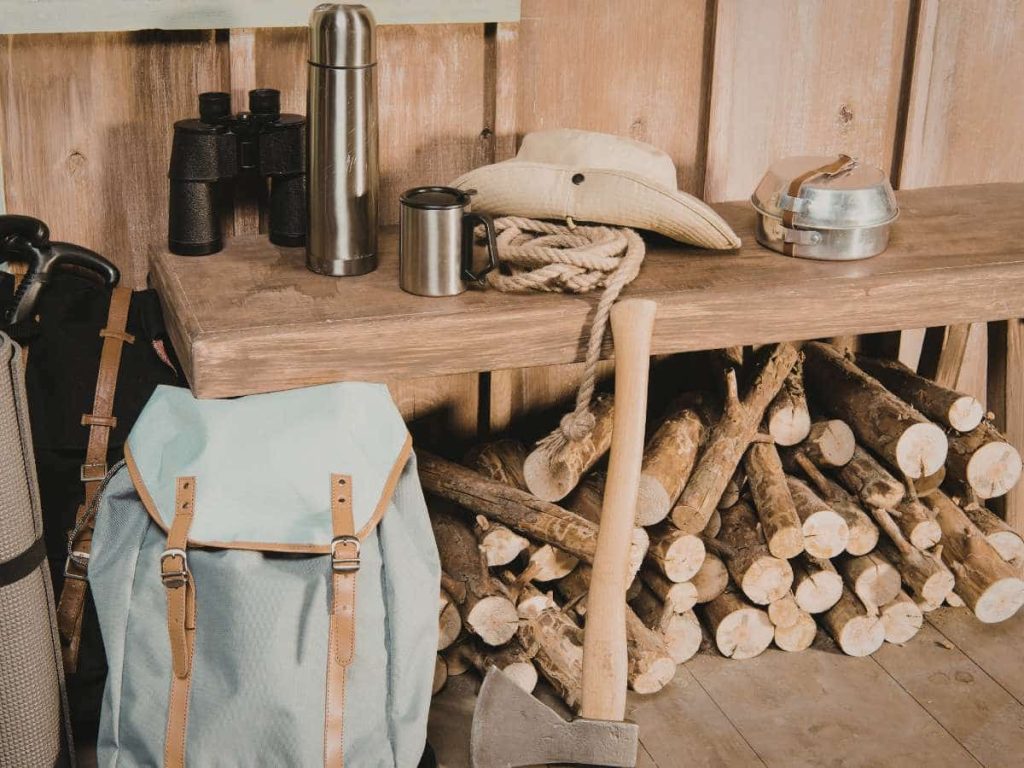
Most camping gear, reassuringly, falls into the first category.
The stuff that’s generally fine
Anything soft, simple, and not especially interesting from a security point of view tends to pass through without issue.
That includes:
- Tents
- Sleeping bags
- Clothing
- Backpacks
- Sleeping mats
In other words, the core of your setup is rarely the problem. You could pack for a perfectly comfortable trip, something along the lines of what we cover in guides like essential camping gear or even a more stripped-back approach if you’re camping without a car (which presumably is the case if camping overseas!) and none of it is likely to raise an eyebrow.
If your bag is full of fabric and fairly obvious outdoor gear, it’s about as unremarkable as luggage gets.
The things that need a bit of thought
This is where you move into slightly more ambiguous territory.
Not dangerous, or banned, but not entirely clear-cut either.
Things like:
- Tent pegs
- Poles
- Compact tools
- Hiking poles
These all fall into that category of items that are perfectly normal in context, but look a little less obvious when reduced to shapes on a scanner. They’re not a problem, but they are better placed in checked luggage, without prompting any extra interest.
Camping stoves also sit here, with one important caveat…
You can take them, but only if they’re completely clean. No fuel residue, no lingering smell, nothing that suggests they’ve recently been doing what they were designed to do. If you’re not sure what a simple, travel-friendly setup looks like in the first place, it’s worth having a look at something like our guide to the best camping stove, because not all stoves are equally “cooperative” when it comes to flying.
The things that are best left behind
And then there’s the category that removes all ambiguity.
Fuel.
Gas canisters, liquid fuel, solid fuel tablets, even containers that have previously held fuel, these are almost always a firm no. It doesn’t matter how carefully you pack them or how empty they seem, they’re not going to make the journey with you.
This is easily the most common point where people run into problems, usually because it feels like such a small, harmless thing to bring.
It isn’t, at least not from an airline’s point of view.
The simplest solution is not to try and work around it at all. Just plan to pick up fuel when you arrive. It’s easier, it’s cheaper, and it removes the only part of your packing list that tends to cause real issues.
Fuel is widely available in most places people go camping. Outdoor shops, supermarkets, even small local stores in some areas. And if you’re thinking about the environmental side of things, it’s also worth understanding how to deal with them properly afterwards, which we’ve covered in our guide to can camping gas canisters be recycled.
Carry-On vs Checked Luggage (What Goes Where)
Once you’ve accepted that a few things aren’t coming with you, the whole process becomes much easier.
Because at that point, you’re no longer trying to figure out if something is allowed. You’re just deciding where it goes.
And this is where a lot of people overcomplicate things unnecessarily.
In reality, the divide is fairly simple.
If something looks completely harmless and wouldn’t raise an eyebrow in a normal bag, it can usually go in your carry-on. If it looks like it might need explaining, it goes in the hold.
That one rule covers most situations surprisingly well.
What usually goes in your carry-on
Your carry-on is best reserved for the things that are:
- lightweight
- non-metallic
- clearly not dangerous
So things like:
- Clothing
- Small accessories
- Headtorches
- Sleeping bag liners
- Basic soft items
These are the items you might want easy access to anyway, and they’re unlikely to attract any attention going through security.
There’s also a practical advantage here.
If your checked luggage decides to take a slightly different holiday to you (we’ve all been there unfortunately!) at least you’ll still have the basics covered.
What’s better off in checked luggage
This is where most of your actual camping kit ends up.
Things like:
- Tents
- Tent poles and pegs
- Stoves (cleaned, as mentioned earlier)
- Hiking poles
- Anything even slightly sharp or solid
All of these are perfectly fine, they just make more sense in the hold, where they won’t need to be questioned or explained.
It’s less about strict rules and more about avoiding unnecessary friction.
If an item could look unusual on a scanner, even if it’s completely harmless, it’s usually easier to pack it in checked luggage and forget about it.
The practical way to think about it
At this point, you’re not really dealing with complicated regulations.
You’re just sorting your gear into two piles:
- Things that clearly won’t be an issue
- Things that might require a second look
The first pile goes with you.
The second pile goes underneath you.
Once you approach it like that, the whole process becomes much more straightforward. And once you’ve decided what goes where, the next step is making sure it’s packed in a way that doesn’t cause problems later on…
How to Pack Camping Gear for Air Travel (Without It Becoming a Problem Later)
Once you’ve worked out what’s coming with you and where it’s going, the last piece of the puzzle is how you actually pack it.
And this is where things tend to go one of two ways.
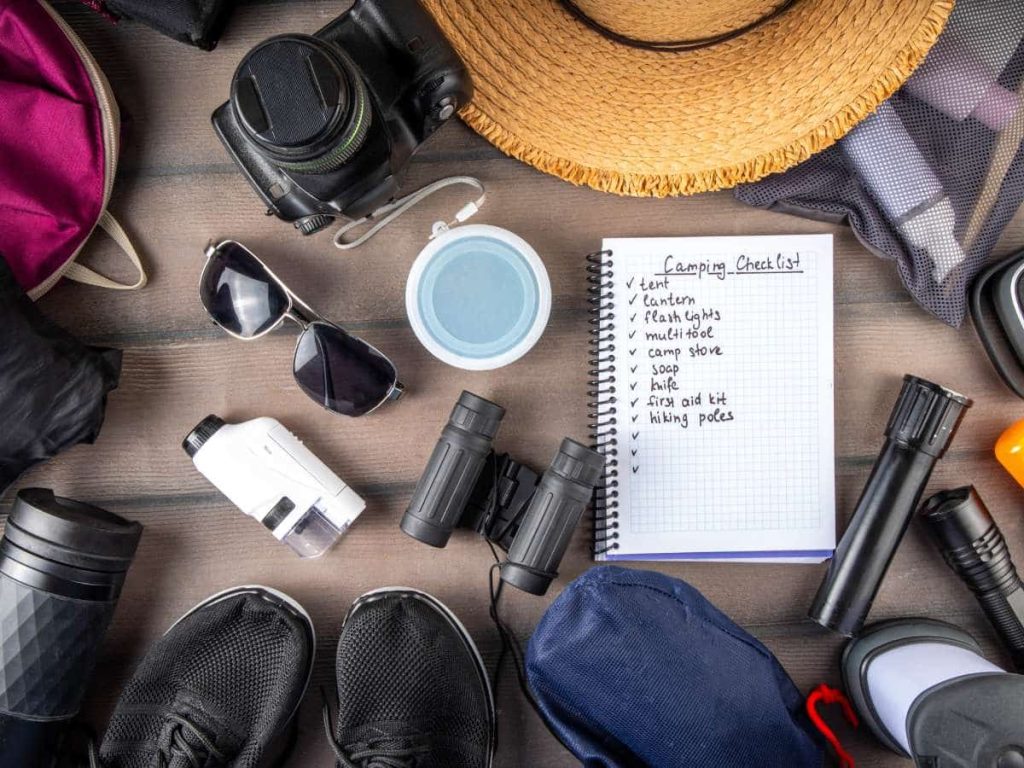
Either everything arrives neatly, intact, and exactly where you expect it to be… or you open your bag at the other end to find a slightly chaotic arrangement of bent pegs, damp fabric, and the vague sense that something important has shifted position somewhere over Europe.
The difference between the two is rarely luck; it’s just a bit of forethought.
Start with the obvious (but often ignored): clean everything
Airports, as a general rule, are not especially fond of dirt.
Not in a moral sense, just in a “we’d rather not deal with whatever this is” sense.
If your tent is still holding onto half a field, your boots look like they’ve recently lost a disagreement with a bog, or your gear smells like it’s been living in a damp shed, there’s a good chance your bag gets opened.
Not confiscated, just… investigated.
A quick clean beforehand avoids all of that.
It also has the added benefit of making everything much nicer to deal with when you arrive, particularly if you’re setting up somewhere warm, coastal, or sandy, like the kind of trips we talk about in our guide to beach camping.
Protect the things that don’t enjoy being crushed
Luggage handling is not a gentle process.
Your bag will be lifted, dropped, stacked, shifted, and occasionally treated with a level of enthusiasm that suggests someone is in a mild hurry.
So anything rigid, sharp, or slightly delicate needs a bit of protection.
Tent poles, pegs, and stoves should be packed in a way that stops them from:
- bending
- puncturing something else
- rattling around freely
A simple trick is to bundle them together and surround them with softer items, clothing works surprisingly well for this. It keeps everything in place and saves you from discovering that your tent now has a slightly more abstract structure than intended.
Compress what you can (but don’t overdo it)
Soft gear is where you can save space.
Sleeping bags, clothing, and anything fabric-based can be compressed down quite significantly, especially if you’re trying to travel light.
That said, there’s a balance.
Over-compressing everything into one tightly packed mass tends to make it harder to find things later, which is not ideal when you’ve just arrived and would quite like to locate your tent before sunset.
Think in terms of “layers”, not just items
One of the easiest ways to pack is to stop thinking about individual pieces of gear and start thinking in layers.
- A base layer of heavier, more durable items
- A middle layer of softer, protective gear
- A top layer of things you might want quickly
It’s not complicated, but it keeps everything stable and makes unpacking feel less like a minor excavation project.
Keep the important things easy to reach
There’s always a small window at the other end of a flight where you need things to be as simple as possible.
You’re slightly tired, slightly disoriented, and not especially interested in digging through your entire bag to find a headtorch or a clean pair of socks.
So it’s worth keeping a few key items easy to access:
- Something warm
- Something dry
- Basic essentials
If you’re travelling with others, or heading straight into a setup situation, this becomes even more useful, particularly for trips that involve a bit more coordination, like the kind we cover in family camping 101.
Don’t pack “just in case” gear
This is the one that quietly causes most problems.
You start adding things that might be useful. Then things that could be useful. Then things that would be useful in a very specific and unlikely scenario.
Before long, you’re carrying more than you need, making your bag heavier, harder to organise, and slightly more stressful to deal with at every stage.
Flying has a way of exposing this kind of packing.
If something isn’t clearly useful, it’s probably not worth bringing.
The simple way to think about it
You’re not trying to pack perfectly – you’re just trying to avoid any obvious issues.
A clean, organised, reasonably light bag that holds together when it’s moved around will get you through the airport, onto the plane, and out the other side with far less effort than one that’s been packed in a rush with everything thrown in “just in case”.
And once you’ve done that, the whole experience starts to feel a lot less like a logistical exercise… and a lot more like the start of an exciting trip.
Airport & Security Tips (What Actually Happens on the Day)
By the time you get to the airport, most of the important decisions have already been made.
Your gear is packed, you’ve decided what’s coming with you, and everything is sitting in your bag looking reasonably innocent.
From this point on, it’s less about preparation and more about how smoothly things move through the system.
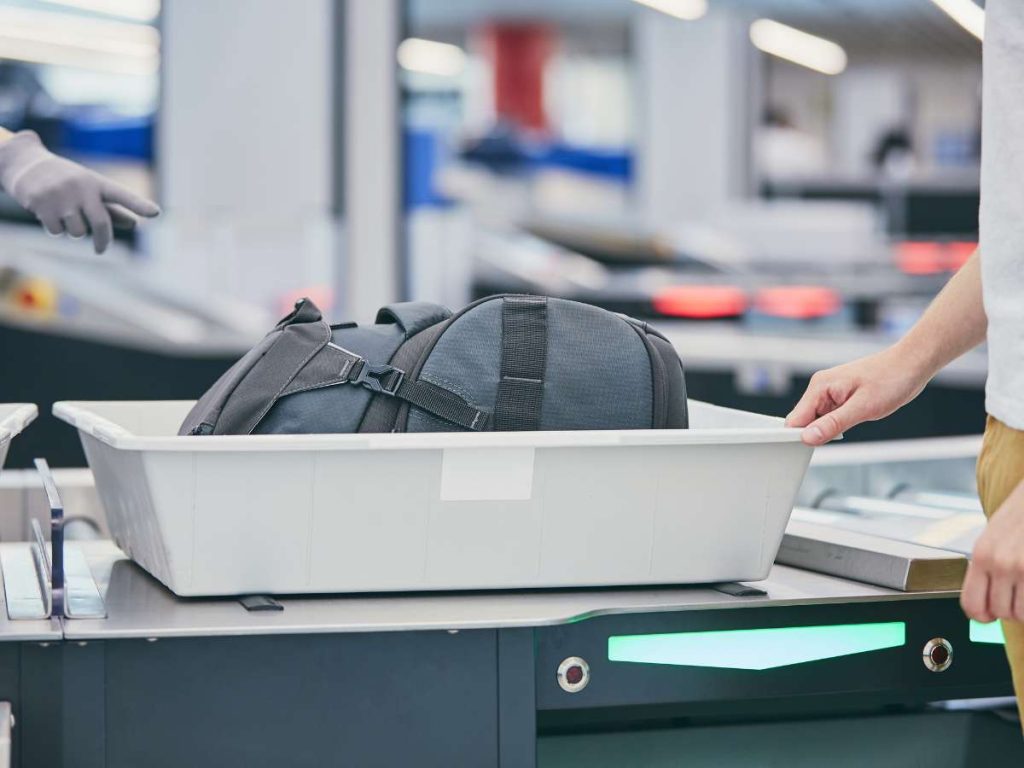
And in most cases, they do.
But there are a few small details that make the difference between everything feeling effortless and everything feeling slightly… drawn out.
Bags do get checked (and it’s not a big deal)
One of the easiest ways to make the whole experience feel more stressful than it needs to be is to assume that any kind of inspection means something has gone wrong.
It doesn’t.
Camping gear, especially anything with structure or metal components, can look a bit unusual on a scanner. So it’s not uncommon for a bag to be opened, looked at briefly, and then sent on its way again.
This is completely normal.
If your gear is packed neatly and doesn’t contain anything questionable, it’s usually a very quick process.
Neat packing helps more than you’d expect
Airport staff aren’t trying to understand your setup.
They’re trying to make quick decisions based on what they can see.
So if your bag opens and everything is loosely organised, easy to identify, and not tangled together, it tends to move along without much interest.
If it opens and looks like a tightly packed mystery, things slow down.
Give yourself more time than you think you need
This isn’t specific to camping gear, but it becomes more relevant when you’re travelling with something slightly out of the ordinary.
Most of the time, everything goes straight through.
Occasionally, something gets checked.
Very occasionally, something takes a bit longer than expected.
None of this is a problem if you’ve built in a bit of time. It only becomes stressful when you haven’t.
Be prepared to answer simple questions
If your bag is opened, you might get a quick question or two.
“What is this?”
“Is this used for camping?”
“Is it clean?”
Nothing complicated.
And the easiest way to deal with it is simply to answer clearly and move on. There’s no need to explain your entire setup or justify every item.
Most of the time, it’s over in a matter of seconds.
The small things that make a difference
There are a few details that don’t seem important beforehand, but make the experience noticeably smoother:
- Gear that’s clean and dry
- Items grouped together logically
- Nothing hidden or difficult to access
- A bag that opens without everything spilling out
None of these are essential, but together they create a situation where there’s very little reason for anyone to take a closer look.
The overall experience
For most people, flying with camping gear ends up being far less eventful than expected.
The build-up tends to be the most complicated part.
Once you’re actually there, it’s usually just a case of moving through the same process as everyone else, with the occasional extra glance at your bag along the way.
International Travel Differences (Why It’s Not Always Exactly the Same)
Just when you feel like you’ve got the whole thing worked out, there’s one final detail that quietly reintroduces a bit of uncertainty.
Not all airports, airlines, or countries approach things in quite the same way.
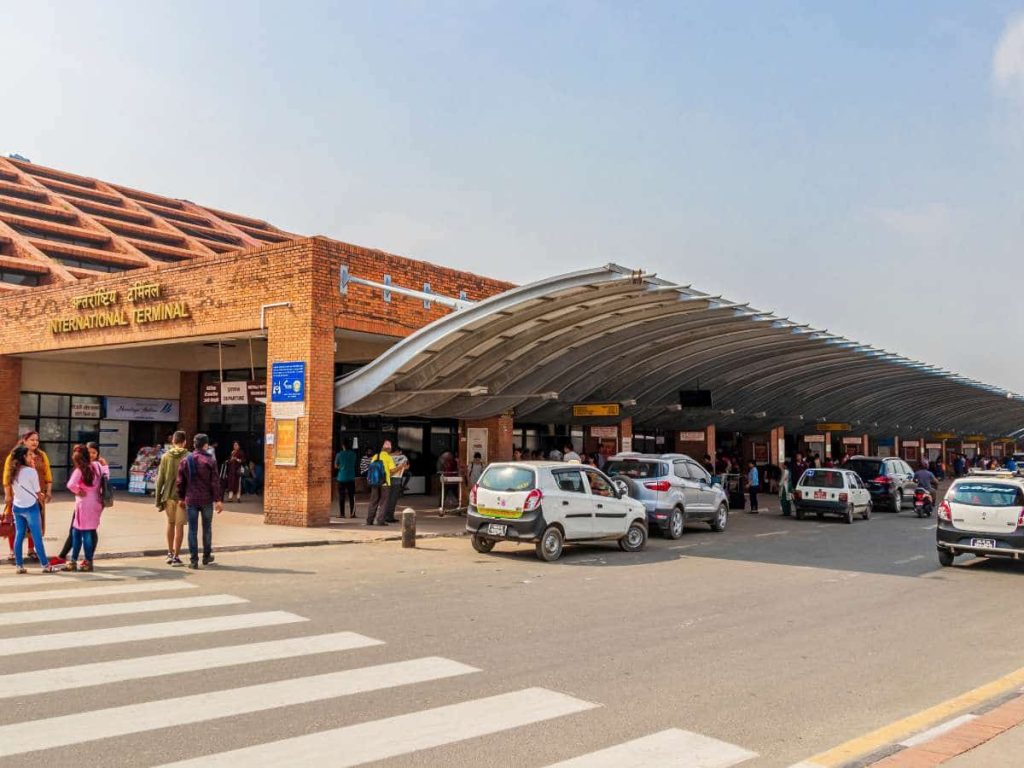
Not wildly differently, you’re not suddenly stepping into a completely new system, but enough that it’s worth being aware of before you go.
The general rules tend to stay the same.
Soft gear is fine. Sharp items go in checked luggage. Fuel isn’t coming with you.
What changes is how closely those rules are applied, and how much curiosity your bag attracts along the way.
Different places, slightly different levels of interest
Some airports are extremely efficient.
Your bag goes through, no one gives it a second look, and you start to wonder why you spent so long thinking about it in the first place.
Others are… a bit more thorough.
Not in a difficult way, just in a “let’s have a quick look at this” kind of way. You might find your bag opened more often, or a couple more questions asked, even when everything is packed exactly as it should be.
Neither is a problem.
It just means the experience isn’t always identical from one place to the next.
Airlines have their own interpretations
On top of that, airlines occasionally have their own preferences layered over the general rules.
Again, nothing dramatic, but enough that something considered perfectly routine by one airline might be treated a little more cautiously by another.
This is usually where people get caught slightly off guard.
They’ve flown with something before without issue, assume it will be the same again, and then find themselves having a slightly longer conversation than expected.
A quick check of your airline’s guidance beforehand can save a surprising amount of uncertainty later on. Even something as straightforward as a camping stove can be interpreted differently depending on how strict the airline chooses to be.
Domestic vs international (the subtle shift)
If you’ve flown domestically with camping gear before, international travel can feel just slightly more… attentive.
There are simply more layers involved. More checks, more transfers, more opportunities for something to be looked at again.
Not because anything is wrong, but just because it’s passing through more hands.
This is where neat packing and simple setups really start to pay off. The easier your bag is to understand at a glance, the less likely it is to slow things down as it moves through different systems.
The advantage of keeping things simple
At this point, the benefit of a simple, well-thought-out setup becomes very obvious.
Not in a theoretical way, but in a practical, real-world sense.
Fewer items, fewer questions. Cleaner gear, quicker checks. A straightforward bag, a straightforward journey.
And while you don’t need to overthink it, having a quick look at something like gov.uk hand luggage restrictions before you travel can give you a baseline for what’s expected, particularly if you’re flying out of or through the UK.
The simple way to approach it
You don’t need to memorise a different set of rules for every country.
You just need to understand that there’s a bit of variation, and leave yourself enough flexibility to deal with it if it comes up.
Most of the time, nothing changes at all.
And the rest of the time, it’s just a slightly closer look and a couple of extra seconds before everything carries on as normal.
Frequently Asked Questions
What camping gear is actually worth taking on a flight?
This is usually where people start refining things a bit.
Once you realise you can’t bring everything, the question becomes what’s actually worth the effort. In most cases, it’s the core items you know you’ll rely on, your tent, sleep setup, and a few key bits of kit you’re comfortable using.
Everything else is negotiable.
Is it better to bring your own gear or buy it when you arrive?
It depends on the trip.
For short trips or destinations with good outdoor shops, buying a few things locally can make life much easier. For longer trips, or when you already have gear you trust, bringing your own tends to make more sense.
A lot of people end up with a mix of both.
Bring the things that matter, and pick up anything else as needed. It’s a similar mindset to what we talk about in our post about camping on a budget – where flexibility often works better than trying to plan everything perfectly in advance.
Can you fly with camping gear for wild camping trips?
Yes, but it does add another layer to think about.
Flying somewhere and heading straight into a wild camping setup means you’re relying entirely on what you’ve brought (or can source locally), so your packing needs to be a bit more deliberate.
It’s also worth understanding the local rules before you go, as they vary quite a lot depending on the country. If you’re used to UK rules, for example, you’ll already know how different things can be between wilding camping in England and Wales, and wild camping in Scotland.
That same variation applies internationally too.
How do you manage food when flying with camping gear?
Food is one of those things that’s much easier to deal with once you arrive.
Trying to plan meals in advance, pack them, and transport everything tends to create more hassle than it solves. Picking things up locally and keeping meals simple usually works better.
If you want to keep things easy once you’re there, it helps to have a few simple ideas in mind, like these easy camping meals, so you’re not standing there wondering what to cook.
What if your gear doesn’t arrive with you?
It’s rare, but it does happen.
This is where having a slightly simplified approach helps. If your setup relies heavily on very specific items, it can be harder to adapt. If it’s more flexible, you can usually replace or work around things without too much trouble.
Keeping essentials in your carry-on where possible helps, but beyond that, it’s mostly about being able to adjust.
Is flying with camping gear expensive?
It can be, but it doesn’t have to be.
Airline baggage fees, extra weight, and oversized items can add up if you’re bringing a lot of gear. But if you keep things relatively simple and travel a bit lighter, it’s often no more expensive than travelling normally.
A lot of it just comes down to how much you bring and how complicated you make it, which is why the cost of camping can vary so much in the first place.
Does flying change how you should choose your camping gear?
Slightly, yes.
Not in a way that requires a completely different setup, but enough that size, weight, and simplicity start to matter more. Gear that’s easy to pack, easy to carry, and easy to explain tends to work best.
It’s one of the reasons people often shift towards simpler systems over time, because they’re easier to manage not just in the wild, but on the way there as well.
Can you travel with camping gear and still keep things comfortable?
You can, but comfort tends to come from the right choices rather than more gear.
A good sleep setup, decent clothing, and a few well-chosen extras will usually do more for comfort than bringing everything you own.
If that balance is something you’re still figuring out, getting your sleep setup right makes the biggest difference, especially when you’re camping with a bad back.
Final Thoughts
By the time you get to the end of all this, flying with camping gear starts to feel a lot less like a guessing game and a lot more like a simple set of trade-offs.
You’re not trying to bring everything; you’re just bringing what makes sense.
A setup that’s easy to pack, easy to move through an airport, and easy to deal with when you arrive will always beat one that technically includes everything but makes the whole trip harder than it needs to be.
And that’s usually the shift that happens after the first trip.
You stop packing for every possible scenario and start packing for the one you’re actually going on. You bring fewer things, make a few smarter choices, and everything feels noticeably smoother from the moment you leave the house to the moment you set up.
There’ll still be small things you tweak next time.
Something you didn’t use. Something you wish you’d brought. Something you realise you could’ve done without.
But that’s part of it.
The difference is, you’re no longer trying to work it all out at the airport.
