There’s a growing movement among modern campers: ditching the car and venturing out into the wild without four wheels. For some, it’s about lowering their carbon footprint. For others, it’s about necessity – not driving, or wanting to travel light. But for many, it’s about slowing down. Removing the rush. Finding freedom in simplicity.
Camping without a car isn’t just possible – it’s often more rewarding than you might think. But it does require a different mindset and a new approach to logistics, gear, and planning. This in-depth guide is your roadmap to doing it right, whether you’re backpacking, train-hopping, or hopping off the bus with nothing but a rucksack and a grin.
To camp without a car, use public transport to access nearby nature (trains, buses, rideshares), pack ultra-light gear, choose accessible campsites, and plan carefully for food, safety, and weather. With the right preparation and mindset, car-free camping can be a liberating, low-impact way to enjoy the outdoors.
But before we get too excited, let’s start from the ground up.
Contents
- Why Go Camping Without a Car?
- Is It More Difficult?
- The Key to Car-Free Camping: Planning with Precision
- Choosing the Right Campsite (and How to Get There)
- Pack Smarter, Not Heavier
- Embrace Public Transport
- Walking or Biking Into Camp
- Food & Cooking Without a Car
- Staying Safe Without a Car to Flee To
- Wild Camping Without a Car: The Ultimate Freedom?
- Camping Without a Car: Frequently Asked Questions
- A Few Final Thoughts
Why Go Camping Without a Car?
The obvious answer is – because you can. For decades, camping and cars have been tied together like marshmallows and campfires. Most of us were introduced to the outdoors by piling into the family hatchback with a tent, a cooler, and a boot full of gear.

But step outside that, and you discover a very different experience – one that’s often quieter, cheaper, and surprisingly liberating.
A More Sustainable Way to Travel
Transport is one of the biggest contributors to individual carbon footprints, and cutting out car journeys is one of the most direct ways to reduce yours. In fact, research shows that swapping one long car journey for public transport or cycling can save as much CO₂ as skipping meat for a week. When you camp without a car, you’re not just reducing emissions, you’re actively aligning your love of nature with protecting it.
It’s the kind of choice that feels small on paper but significant in practice. Imagine hiking into a national park without the drone of engines, or setting up your tent in a place where no tarmac road can reach. Your trip instantly feels lighter – not just on your back, but on the planet.
The Freedom of Slow Travel
Driving gets you places quickly, but it also traps you in a bubble of glass and metal. Without a car, the journey itself becomes part of the adventure. You notice the little things: the way the landscape changes mile by mile, the conversations you have with strangers on a train, the rhythm of your footsteps as you hike into camp.
This is slow travel in its purest form. You’re no longer rushing from A to B. You’re connected to the land you’re moving through. And when you finally drop your pack at your chosen campsite, there’s a sense of having earned your night under the stars.
For some, this slower pace isn’t just an alternative, it’s the whole point. A chance to strip life back to basics, to escape traffic jams and service stations, and to immerse yourself in the kind of silence that only the outdoors can offer.
Access to Hidden Places
Ironically, cars can sometimes be limiting. Campsites with large car parks tend to get crowded. Scenic spots with laybys fill up fast. But go car-free, and suddenly you can reach places others can’t. Remote bothies in Scotland, cliff-top trails in Spain, mountain huts in the Alps, hidden coves in Greece; these are the kind of places where no road leads, but a pair of boots or a bicycle will take you just fine.
It’s also worth mentioning the legal side of wild camping. In Scotland, Scandinavia, New Zealand, and certain parts of the US, the right to camp freely is protected by law. Many of the best wild camping spots in these regions are accessible only on foot or by bike. If you’ve ever dreamed of pitching a tent beside a loch, a fjord, or a deserted beach, camping without a car is often the only way to get there. (If you’re UK-based, our full wild camping law guide breaks this down in detail.)
Personal Growth and Challenge
Let’s be honest: car-free camping takes effort. You can’t just throw a pile of gear into the boot and drive off. You have to think carefully about what really matters. You’ll carry every item on your back or bike, so excess falls away quickly. And that stripping back – to shelter, food, warmth, and water – can be strangely satisfying.
It’s also a personal challenge. Walking into camp with nothing but what you can carry builds resilience and confidence. You learn how to plan, adapt, and rely on yourself. For many people, that’s part of the appeal. It’s camping in its rawest, most elemental form.
And if you’re heading out on your own, the challenge (and the reward) doubles. Solo camping without a car strips the experience back even further, pushing you to rely on your own decisions, your own pace, and your own resilience. It can feel daunting at first, but it’s also one of the most empowering ways to connect with nature. You learn to trust yourself, to enjoy your own company, and to discover that solitude in the outdoors isn’t loneliness, it’s freedom. If you’re curious, we’ve put together a full guide to solo camping that walks you through making the most of the quiet.
A Deeper Connection to the Journey
Without a car, every step, every pedal, every train ride becomes part of the story. You might stumble across a village bakery and grab warm bread for camp. You might meet other hikers swapping tips at a trailhead bus stop. You might arrive late, tired, and muddy, but you’ll know that every moment – the planning, the effort, the unexpected detours – is part of your adventure.
And that’s the biggest reason of all: car-free camping doesn’t just get you outdoors. It changes how you experience the outdoors.
Is It More Difficult?
The short answer is: yes and no. It’s not ‘harder’ in the sense of requiring superhuman endurance or specialist knowledge, but it is different. Without a car, you lose that comforting safety net of being able to haul unlimited gear or retreat to your car if things go wrong. Instead, you’re forced to think carefully about weight, distance, and logistics.

For many campers, that shift in mindset is the very thing that makes car-free trips so rewarding. You swap excess for essentials. You trade convenience for creativity. You learn to appreciate the simplicity of carrying only what you need and making the most of it.
There are challenges, of course. You can’t throw half the kitchen in the boot “just in case.” You’ll have to walk further, carry more, and plan better. But the payoff is a trip that feels leaner, more purposeful, and often more immersive than car-based camping.
And here’s the other truth: the limits of car-free camping often become its strengths. The fact you can’t overpack forces you to refine your kit list. The absence of a vehicle encourages you to think about safety and planning in more deliberate ways. And when you’re travelling by foot, bike, or public transport, the journey itself becomes part of the adventure – not just the means of getting there.
Mental Resilience and Adaptability
Car-free camping doesn’t just build muscles in your legs, it strengthens the mind. When plans inevitably shift – a bus runs late, the weather turns, or you realise you left behind the extra torch batteries – you adapt. You learn to problem-solve with what you’ve got, instead of what you wish you had. This resilience is one of the hidden gifts of car-free trips. It makes you calmer in the face of setbacks, more appreciative of small comforts, and more attuned to the present moment. In a world where convenience often dulls our resourcefulness, car-free camping quietly retrains us to cope, improvise, and even thrive when things don’t go exactly to plan.
The Key to Car-Free Camping: Planning with Precision
If you’re going camping without a car, planning isn’t just a nice-to-have – it’s the difference between a stress-free trip and one where you find yourself stranded, exhausted, or carrying way more than you need.

A little extra thought up front pays off in spades once you’re out there. Think of it as building your own safety net before stepping into the wild.
There are three areas where smart planning makes the biggest impact: your route, your campsite, and your gear. We’ll cover these in greater detail later, but for now let’s look at the basics.
Nailing Down Your Route
Without a car, your route is everything. How you get from home to the trail, and from the trail to your campsite, will shape the whole trip.
- Public transport first: Start by checking train, bus, or ferry timetables for where you’re headed. Factor in the time it’ll take to connect those final dots on foot or bike. Google Maps is a great starting point, but local transport websites (and even Facebook groups) are often far more accurate.
- Plan for delays: Assume at least one connection will be late. Build in buffer time so you’re not pitching a tent in the dark.
- Last mile strategy: How are you actually getting from the station or stop to your site? A two-mile walk with a pack can be a pleasant warmup. Ten miles, on the other hand, can turn into a slog.
Picking the Right Campsite
You can’t just rock up anywhere and hope for the best. Especially without a car, accessibility matters.
- Accessible yet remote: Look for campsites that balance a sense of escape with reasonable access from transport links. Many sites actually list “nearest train station” on their website – dig into those details.
- Book ahead: Popular sites fill up quickly, and without wheels, your options for moving on are limited. Always secure your spot before setting off.
- Wild camping? That’s a different ball game (we’ll cover it later), but the principle is the same: know exactly where you’re headed, and have a backup plan if your first choice doesn’t work out.
Gear with Purpose
Every ounce matters when you’re the engine. With no boot to chuck everything into, you’ll need to be ruthless about what earns its place in your pack.
- Lightweight and multi-use: Think of gear that does more than one job (a scarf that doubles as a towel, a pan lid that’s also a plate).
- Back comfort is king: If you’ve got a dodgy back or just want a good night’s sleep, invest in a supportive, lightweight camping mattress (we’ve covered this in our mattress guide).
- Test runs help: Do a trial pack, throw it on your shoulders, and go for a short walk before your trip. If it feels unmanageable in your street, it’ll be worse after an uphill hike.
Build in Flexibility
Even the best-laid plans meet reality. Buses get cancelled. Trails get flooded. Gear fails. Having a plan B (and even a plan C) isn’t pessimism, it’s just smart. Make a note of alternate campsites, alternate routes, and places to bail out if you really need to.
Choosing the Right Campsite (and How to Get There)
Once you’ve mapped out the broad strokes of your journey, the next step is deciding exactly where you’ll sleep. With a car, you can often wing it: if one site’s full, you just drive to the next. Without that safety net, your choice of campsite matters a lot more.

It’s not just about scenery, it’s about how easily you can reach it, how well it fits your needs, and how confident you’ll feel getting there on foot, by bike, or via public transport.
Accessibility Is Everything
When you’re car-free, accessibility becomes just as important as location. A site that looks idyllic on Instagram can turn into a logistical nightmare if it requires a two-hour uphill hike from the nearest bus stop. Before booking, zoom in on the maps and check the distance between your final transport hub and the site entrance.
- Walking distance sweet spot: Under 3 km (about 2 miles) is ideal with a backpack. Beyond that, you’ll need to factor in terrain, gradient, and daylight.
- Transport links: Look for sites that mention the nearest train station or bus stop in their directions – this is usually a sign they’re used to welcoming car-free campers. If it’s unclear, send the site an email. A quick “How easy is it to reach you without a car?” will often get you the honest answer.
- Don’t forget the way back: It’s easy to focus on arriving, but make sure return journeys line up with checkout times. Missing the only Sunday bus out of a rural valley isn’t much fun.
Different Types of Campsites (and What They Mean Without a Car)
Not all campsites are created equal, especially when you’re arriving on foot or by bike:
- Established campgrounds: These often have excellent directions, clear signage, and facilities like toilets, showers, and food shops. They’re a safe bet if you’re new to car-free camping.
- Eco-campsites: Many eco-friendly sites actively encourage arriving without a car. Some even offer discounts or luggage transport for car-free travellers. They’re worth seeking out if sustainability is part of your motivation.
- Remote or “back-to-basics” sites: Great for peace and solitude, but double-check how you’ll reach them. A remote site might sound appealing until you’re dragging your pack down a five-mile unlit farm track at 10 pm.
The Importance of Booking Ahead
Car campers can often show up and improvise if a site is full. Without wheels, that’s not an option. Book well in advance, especially during summer weekends and holidays. This is doubly important if your chosen site is small, eco-focused, or in a high-demand area like the Lake District, Yosemite, or the Alps. Having a guaranteed pitch means you can travel with confidence, rather than anxiety.
Global Examples of Car-Free Campsite Access
To make this practical, here are a few regions where camping without a car works brilliantly:
- UK: In the Lake District, campsites around Windermere and Keswick are well-served by local buses. In Scotland, west-coast campsites often connect seamlessly with train and ferry routes – you can hop from Glasgow to Oban, ferry to Mull, then walk straight to a tent-friendly site.
- Europe: Switzerland is the gold standard. Many campsites are located directly next to train stations or lake ferries. In France, you’ll find plenty of riverside sites along train lines in the Dordogne and Loire valleys.
- US: While distances can be challenging, some National Parks make it possible. Yosemite and Zion both run shuttle buses directly to certain campgrounds, meaning you can skip the car park altogether.
- Asia: Japan’s rural train system makes car-free camping surprisingly simple. Many campsites in Hokkaido and Honshu are just a short walk or bus ride from a station, and local buses tend to be punctual to the minute.
Getting There Smoothly: Pro Tips
- Pack for the last leg: Assume you’ll walk at least a mile from the nearest stop. Pack straps and adjust your load so it’s comfortable.
- Ask about pickups: Smaller, family-run sites will sometimes pick you up from the station if you arrange it in advance. Don’t be shy about asking – it can save a long, heavy walk.
- Budget for a short taxi: In rural areas, sometimes the most efficient option is to take public transport most of the way, then spend a little on a taxi for the final stretch. It’s still far cheaper (and greener) than driving the whole way.
Pro tip: When choosing a site, always check their check-in times, dog policies (if relevant), and whether they offer basic supplies. Some remote sites might not have a shop or even clean water, so arrive prepared.
Pack Smarter, Not Heavier
If travelling to a campsite by car teaches you anything, it’s how easy it is to overpack. A boot gives the illusion of infinite space, so in go the spare shoes, the just-in-case blanket, and the second cooler you definitely won’t need. When you’re travelling without a car, though, your back, shoulders, or bike panniers are the boot, and suddenly every extra item is a decision you’ll regret after the first uphill mile.

Packing smarter isn’t just about going light. It’s about choosing gear that’s purposeful, multi-functional, and suited to a car-free journey.
Travel Light, But Not Miserable
The temptation is to go ultra-minimal and sacrifice comfort, but that can backfire. Sleep badly, stay cold, or eat nothing but cereal bars, and you’ll be counting the hours until you can head home. Smarter packing means carrying just enough to be comfortable without weighing yourself down.
A good rule of thumb: if you’re debating whether to pack something “just in case,” you probably don’t need it. If you’re debating whether to pack something that ensures a decent night’s sleep, warmth, or hydration, it earns its place in your bag.
Multi-Use is Your Best Friend
Every item should ideally do more than one job.
- Cooking gear: A pot lid that doubles as a plate. A mug that works as a measuring cup.
- Clothing: A buff that can be a scarf, hat, or sleep mask. A rain jacket that doubles as a windbreaker.
- Sleeping kit: A lightweight mat or mattress that protects your back and insulates against cold ground.
Pack in Systems, Not Chaos
Car camping often looks like rummaging through a big pile of stuff in the boot. Without a car, chaos will slow you down and test your patience. Packing in ‘systems – small, organised bags for different needs – makes a huge difference.
- Dry bags or stuff sacks: Separate sleep kit, cooking gear, and clothing.
- Accessibility: Keep snacks, water, and a rain jacket in easy reach, not buried at the bottom of your pack.
- Balance: Heavy items go close to your spine and mid-back for better weight distribution.
Don’t Skimp on Sleep and Footwear
If you’re carrying everything yourself, your body will thank you for looking after it.
- Sleep: A lightweight sleeping pad or mattress is worth the weight for spinal support and warmth.
- Footwear: Whether you’re hiking in or just walking from the bus stop, invest in comfortable, broken-in shoes. Nothing ruins a trip like blisters or sore arches.
Test Runs Save Pain Later
One of the simplest yet most overlooked steps: do a test pack at home.
- Load your bag fully.
- Put it on.
- Go for a short walk.
If it feels unbearable on flat streets, it will feel ten times worse up a trail. Adjust, cut items, or rethink your setup before you’re committed on the road.
Leave Room for Food and Water
Don’t pack your bag so tightly that you’ve left no space for supplies you’ll pick up en route. Food and water are heavy but non-negotiable. Always plan where you’ll top up bottles and factor in extra weight for meals if your site doesn’t have a shop nearby.
If you’re new to lightweight packing, REI’s backpacking checklist is a great place to build your base list. And don’t forget, if you’re camping wild, remember the Leave No Trace essentials: trowel, rubbish bag, and biodegradable soap.
Embrace Public Transport (and Learn to Love Timetables)
When you’re camping without a car, public transport isn’t just a means to an end, it is the journey. Trains, buses, and ferries become part of the adventure, connecting the dots between home, town, trail, and campsite.

And if you embrace it, that slower, more deliberate way of travelling can actually make your trip richer.
Mastering the Timetables
Planning your trip around public transport requires a little homework.
- Start with the long leg: Secure your main train, coach, or ferry first, then build the smaller connections around it.
- Check local services: National journey planners are helpful, but local bus company websites or community Facebook groups often reveal more accurate timetables.
- Factor in wiggle room: Rural services are infrequent, and missing a bus can mean a multi-hour wait. Always give yourself extra buffer time, especially on the return leg.
Start by checking route planning apps like Rome2Rio, Google Maps (with public transport toggled on), or your country’s national rail or bus websites. Some rural buses only run a couple of times a day – or not at all on Sundays – so plan with precision and flexibility.
Embracing the Pace
There’s a hidden gift in travelling this way: you’re forced to slow down. Instead of bombing down a motorway at 70 mph, you’re watching countryside roll past from the window of a train, or hopping on a little rural bus that winds through villages you’d never normally see. These moments become part of the trip rather than just the ‘bit before camping’.
Global Examples of Car-Free Travel
- UK: The Settle–Carlisle railway in the Yorkshire Dales drops you off in the heart of walking country, with campsites just a stroll from the station.
- Europe: In Norway, ferries link dramatic fjordside campsites directly with towns. In the Netherlands, trains and cycle paths connect seamlessly, making bikepacking a breeze.
- US: Amtrak routes like the California Zephyr can get you surprisingly close to National Parks, with connecting shuttles to campsites.
- Asia: Japan’s countryside rail lines are legendary for their punctuality, and many rural stations have lockers for stashing gear if you want to explore on foot before heading to your campsite.
Practical Hacks for a Smoother Ride
- Travel off-peak: Cheaper fares, quieter carriages, and more space for your pack.
- Reserve a seat if you can: Especially on long-distance trains or ferries, when standing for hours with a rucksack is the last thing you want.
- Scout ticket bundles: Rail passes, regional day tickets, and tourist passes can make car-free travel much cheaper.
- Last-mile tricks: If a bus drops you a little further than expected, having a folding walking pole or even lightweight hiking sandals can save your feet for the main event.
Mindset Shift: From Transit to Travel
The biggest secret is reframing how you see the journey. Yes, public transport can be slow, but it also gives you permission to unplug. Bring a book, journal your trip, or simply look out the window – things you couldn’t do if you were behind the wheel.
Walking or Biking Into Camp
At some point, almost every car-free camping trip boils down to one thing: you, your pack, and your own two legs (or two wheels).

This is where the journey becomes personal. The last stretch to your campsite might be a gentle riverside stroll or a tough uphill grind, but either way it’s the moment you fully leave behind buses, trains, and timetables.
Hiking to Your Campsite
Walking in is the most common way to reach a campsite without a car. It can be as short as a 15-minute amble from a rural station or as ambitious as a full-day trek into the hills.
- Distance reality check: A mile on flat pavement with a pack is fine. A mile up rocky terrain in heat or rain is a whole different story. Check elevation and surfaces before committing.
- Pack weight matters: Stick to the classic rule of thumb – no more than 20–25% of your body weight on your back. Any more, and that ‘short walk’ starts to feel like punishment.
- Footwear is non-negotiable: Lightweight hiking boots and a decent pair of hiking socks make all the difference. Blisters or sore arches can cut a trip short.
- Navigation tools: Don’t rely solely on your phone. Apps like AllTrails and Komoot are brilliant, but bring a backup paper map if you’re heading into remote areas.
The Joy of Bikepacking
If walking feels too slow, or you want to cover bigger distances, bikepacking is the perfect middle ground. You can still travel light, stay flexible, and reach wild-feeling spots – but you’ll roll there instead of trudge.
- Why it works: Bikes can handle that ‘awkward last 10 miles’ from a train station to a rural campsite much faster than your feet.
- Packing smart: Use panniers or a bikepacking saddle bag to spread the load. A heavy backpack on your shoulders will ruin the ride.
- Terrain check: Don’t assume all campsites are cycle-friendly. Double-check that final approach road or trail isn’t a steep gravel climb better suited to mountain goats.
- Lock it up: Not every campsite has bike storage. Bring a lightweight lock so you can leave your bike with peace of mind.
Global Inspiration
- UK: The Coast to Coast walk passes through multiple villages with campgrounds accessible on foot. Scotland’s National Cycle Network links directly to dozens of rural camping spots.
- Europe: The Danube Cycle Path weaves past countless riverside campsites across Germany, Austria, and Hungary. In France, the GR hiking routes connect walkers to a patchwork of simple, affordable campsites.
- US: The Pacific Crest Trail has hiker-friendly campgrounds dotted along its length, while bikepackers flock to the Great Divide route through the Rockies.
- Asia: In South Korea, the 4 Rivers Bike Path is lined with free camping spots right on the trail, making it one of the easiest bikepacking routes in the world.
Tips for Making the Last Stretch Easier
Pace yourself: The last mile can feel like the longest. Rest if you need to – it’s better to arrive a little later in good shape than exhausted and irritable.
Eat before you walk: Fuel up before starting the final approach. Hiking hungry with a heavy pack makes every step harder.
Think about daylight: Always aim to arrive with enough time to pitch camp before dark – trails look very different in fading light.
Food & Cooking Without a Car
Cooking while camping without a car comes down to three things: weight, simplicity, and comfort. With no boot to stash coolers and crates, your food has to be compact, easy to carry, and realistic to cook on lightweight gear.
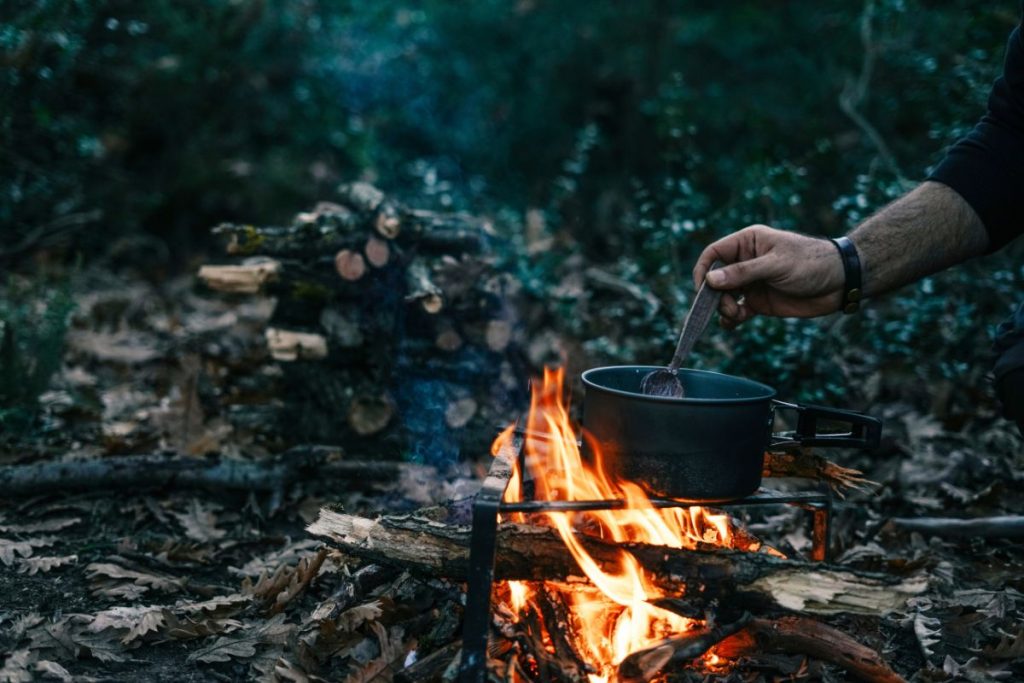
But that doesn’t mean you’re stuck with sad sachets of instant noodles (unless you want to be). With a little planning, you can eat well and even make food a highlight of the trip.
Keep It Lightweight (and Calorie-Dense)
Every gram counts when you’re carrying your own supplies, so think in terms of calories per weight.
- Dry staples: Couscous, rice noodles, oats, and dehydrated meals are light and filling.
- Protein: Sachets of tuna, jerky, nut butters, or powdered protein shake mixes pack a punch without spoiling.
- Snacks with purpose: Trail mix, flapjacks, or energy bars keep you going on the move.
- Comfort extras: A small pack of chocolate, a decent coffee sachet, or a spice mix can do wonders for morale without adding much bulk.
Cooking Gear Without a Car
Forget the sprawling two-ring gas stoves of car camping. For car-free trips, compact and efficient is key.
- Backpacking stoves: Small canister stoves (like Jetboil or MSR PocketRocket) boil water in minutes and pack down to nothing.
- Solid fuel or alcohol stoves: Even lighter, though slower – great if you’re serious about trimming every gram.
- Cookware: One pot, one mug, one spork. That’s often all you need. Anything more just weighs you down.
- Fuel awareness: Always check you can buy the right fuel where you’re going. Not every country sells the same canisters or alcohol fuel bottles.
Water: The Non-Negotiable
Water is heavy, but essential.
- Know your sources: Before you go, research whether your campsite has a tap or if you’ll need to filter from a stream.
- Carry a filter: A lightweight water filter or purification tablets can save you from hauling litres unnecessarily.
- Smart bottles: Collapsible bottles or hydration bladders let you adjust volume without wasting space.
Cooking Without a Car: Global Context
- UK: Many campsites have small shops selling basics like bread, milk, and tinned food – don’t overpack what you can buy locally.
- Europe: Campsites in France, Italy, and Spain often have bakeries or cafés nearby, perfect for supplementing your kit with fresh food.
- US: Car-free National Park campsites often lack shops, so you’ll need to bring in all supplies from the nearest town.
- Asia: In Japan and South Korea, convenience stores near stations are a godsend. You can grab hot food, rice balls, and noodles right before heading into the countryside.
Small Luxuries That Make a Big Difference
Weight is always the excuse not to bring comfort items, but a few carefully chosen luxuries can turn a trip from functional to memorable.
- A sachet of good coffee instead of instant.
- A tiny bottle of olive oil for cooking.
- A collapsible pour-over for a real brew.
- A mini hot sauce or spice kit to brighten up bland meals.
The Golden Rule: Keep It Simple
At the end of a long walk or ride, you won’t want to faff with complex cooking. Stick to meals that need one pot, boil quickly, and don’t create loads of washing up. Your future self (and your pack weight) will thank you.
Backpacking meals like freeze-dried curries, instant noodles, couscous, oats, nut butters, and protein bars are all reliable staples. If you’re camping for multiple nights, bring a mix of fast meals and easy comfort food. Instant miso soup with dried tofu. Vacuum-packed rice and tinned fish. Energy gels and dark chocolate. Small luxuries make a big difference on hard days.
In warmer climates, go easy on perishables unless you know there’s a food stop nearby. If you’re camping within walking distance of a village or small town, pop into the shop once a day for fresh bread, cheese, and veg.
Staying Safe Without a Car to Flee To
One of the biggest mental hurdles with car-free camping is the “what if” factor. What if the weather turns? What if someone gets hurt? What if we run out of supplies? With a car, the fallback option is simple: pack up and drive away.

Without one, you need to think ahead, but that doesn’t mean you’re vulnerable. In fact, planning for safety without a car often makes you more resilient, resourceful, and confident outdoors.
Weather Awareness (and Thunderstorms)
The most common threat to a good trip isn’t wildlife or injury – it’s the weather.
- Check twice: Look at forecasts from multiple sources (apps, local sites, even campsite owners) before heading out. Rural areas often have their own microclimates.
- Thunderstorms: If you’re caught in one, avoid open ground, isolated trees, and ridgelines. Seek lower ground, but not depressions where water pools. Stay in your tent only if it’s properly staked and you’re not at risk of flooding – otherwise, crouch low on your pack or a sleeping mat until it passes. (We’ve got a full thunderstorm guide you can explore for more detail).
- Wind: Pitch tents with the narrow end facing the wind and always carry extra guylines or pegs – the walk in doesn’t feel so bad when you’re not chasing a runaway tent at 3 a.m.
Medical and Emergency Planning
You don’t need a car to be safe, you just need a clear plan.
- First aid kit: A small, well-stocked kit is essential. Don’t overdo it, but make sure it covers blisters, cuts, pain relief, and any personal medications.
- Know your exits: Before pitching camp, note the nearest road, bus stop, or village in case you need to leave quickly.
- Emergency contacts: Save local taxi numbers, campsite phone numbers, and emergency services contacts in your phone and on a bit of paper (in case batteries fail).
- Buddy system: If you’re camping solo, tell someone your exact plans and when you’ll check in. It’s a simple step, but it massively increases safety.
Food, Water, and Supplies
Running out of food or water is more stressful without a boot full of extras.
- Always overpack water purification: Tablets or a filter weigh next to nothing and can save a trip if taps are further apart than expected.
- Emergency rations: A couple of flapjacks or a freeze-dried meal kept in reserve can cover a missed bus or unexpected second night out.
Global Perspective
- UK & Europe: Campsites are often within walking distance of towns or villages, so emergencies usually mean a taxi ride rather than a helicopter rescue.
- US & Canada: Distances are greater, and rural areas more isolated. Build in redundancy – an extra meal, a backup power bank, and a clearer exit plan.
- Asia: Countries like Japan and South Korea tend to have excellent public infrastructure, but language barriers can slow things down. Learn a few key phrases (“hospital,” “bus,” “help”) or have them saved on your phone in translation apps.
The Confidence Factor
The more you prepare, the less you’ll worry. And paradoxically, camping without a car often makes you safer overall, because you have to plan thoroughly. Instead of relying on a quick escape, you’ll already have strategies in place for staying calm, comfortable, and in control.
Wild Camping Without a Car: The Ultimate Freedom?
For many people, camping without a car and wild camping go hand in hand. Once you’re already carrying everything on your back, the freedom of pitching your tent away from busy campsites can feel like the natural next step.

But wild camping without a car comes with its own set of challenges – and rewards. Done responsibly, it can be one of the most memorable outdoor experiences of your life.
Know the Legal Landscape
Wild camping laws vary hugely across the world:
- UK: In Scotland, it’s legal under the Right to Roam (as long as you’re respectful and follow the Scottish Outdoor Access Code). In England and Wales, wild camping is generally not legal without landowner permission – except for certain areas like Dartmoor, where recent rulings have clarified limited rights.
- Europe: Countries like Norway, Sweden, and Finland embrace the concept of “Everyman’s Right” – meaning you can camp almost anywhere for a night or two, provided you leave no trace. Others, like France or Spain, are stricter, though stealthy single-night bivvies are often tolerated in remote areas.
- US & Canada: Rules vary state by state, but Bureau of Land Management (BLM) land and many National Forests allow dispersed camping for free, away from designated sites.
- Asia: Japan is generally strict about wild camping, but stealth camping in rural areas sometimes happens discreetly. In Mongolia, wild camping is essentially part of daily life.
Arriving on Foot or Bike
Car-free wild camping has a few unique advantages:
- Low profile: Without a vehicle parked nearby, you attract far less attention. A tent tucked out of sight blends in much more naturally.
- Flexibility: On foot or bike, you’re free to stop in places a car could never reach. That hidden meadow or forest clearing is suddenly an option.
- Less impact: No tyre tracks, no roadside clutter – just you, your pack, and nature.
How to Choose a Spot (and Stay Safe)
- Arrive late, leave early: Especially in countries where wild camping isn’t technically allowed, this minimises the chance of being asked to move on.
- Stay discreet: Small tents or bivvy bags are ideal. Bright orange festival tents, less so.
- Respect water sources: Camp at least 50 metres from rivers or lakes to protect ecosystems (and avoid condensation or midges).
- Check the forecast: Wild camping means full exposure. Don’t pitch on ridgelines in high winds or flood-prone valleys if heavy rain is coming.
- Have an exit plan: Know where the nearest path, road, or village is if you need to bail quickly.
Leave No Trace (Seriously)
Without the infrastructure of a campsite, it’s entirely on you to protect the landscape.
- Pack out every scrap of rubbish.
- Bury human waste at least 15 cm deep and 50 m away from water sources.
- Avoid fires unless they’re explicitly allowed and conditions are safe. Use a stove instead.
- Leave your spot looking as though no one was ever there.
The Reward
Yes, wild camping without a car can feel more intimidating. But it also offers the purest form of freedom: waking up in a quiet valley with no cars, no neighbours, and no signs of civilisation. It strips the experience down to its simplest form – you, your gear, and the landscape. And when you get it right, it’s hard to beat.
Camping Without a Car: Frequently Asked Questions
Is it really possible to go camping without a car?
Absolutely. People all over the world camp using trains, buses, ferries, bikes, and their own two feet. With a bit of planning, it can be just as easy (and in some cases even easier) than driving. Many campsites are designed with car-free travellers in mind, and in countries like Switzerland, Norway, and Japan, car-free camping is practically the norm.
Is camping without a car harder?
It can feel more complicated at first, but once you adjust your mindset, it’s actually liberating. Instead of overpacking, you carry only what you need. Instead of parking lots and traffic, you’re walking through fields or hopping on scenic trains. The key difference is planning; you’ll need to think about your route, campsite access, and gear more carefully than you would with a car.
Can I wild camp without a car?
Yes, and in some ways it’s even easier. Without a vehicle parked nearby, you’re far less noticeable. Just make sure you know the local laws – in Scotland, Norway, or Finland, for example, it’s legal to camp responsibly almost anywhere. In England, most of the US, or much of Europe, you’ll need to be more discreet and follow the “arrive late, leave early” rule.
What do you eat when camping without a car?
Lightweight, calorie-dense food is your friend: couscous, oats, noodles, tuna sachets, nuts, and dried fruit. Many campers also bring a compact stove for simple hot meals. Depending on the country, you can supplement your supplies at local shops near campsites or stations – in France and Italy, for example, grabbing fresh bread or cheese en route is easy.
How do I carry everything?
Use a good backpack (or panniers if you’re cycling) and keep weight to 20–25% of your body weight. Focus on multi-use gear – one pot for cooking, a buff that works as a scarf or hat, a sleeping mat that doubles as a seat. Packing in small dry bags or stuff sacks also keeps things organised and balanced.
What about safety without a car?
It comes down to preparation. Always carry a small first aid kit, tell someone your plans, and know your nearest bus stop, village, or road in case you need to bail. Weather is often the biggest risk – check forecasts carefully, avoid exposed ground in storms, and carry enough food and water purification to stretch your trip if needed.
Can I camp without a car in the UK?
Yes, though it depends on the region. Many Lake District campsites are accessible by bus from towns like Keswick or Windermere. In Scotland, trains and ferries link directly to remote campgrounds, and wild camping is legal almost everywhere if done responsibly. In England and Wales, wild camping is more restricted, but plenty of established sites are within walking distance of stations or bus stops.
Can I camp without a car in the US?
Yes, though it takes more planning than in Europe. National Parks like Yosemite and Zion run shuttle buses that connect to campgrounds, and dispersed camping is allowed on BLM land and in many National Forests. If you’re heading somewhere remote, plan your food and transport carefully, as services can be few and far between.
Is camping without a car cheaper?
Usually, yes. You’re saving on fuel, parking, and sometimes even campsite fees (many eco-sites offer discounts for car-free travellers). Public transport tickets can add up, but overall costs are often lower – especially if you pack smart and use local shops rather than lugging in expensive gear or food.
If you’re curious about the full picture, we’ve broken down the costs in detail over here: Is Camping Expensive?
A Few Final Thoughts
Camping without a car might sound daunting at first, but once you’ve tried it, it often becomes your favourite way to travel. Stripping things back forces you to plan smarter, pack lighter, and slow down – and in doing so, you discover a version of camping that feels simpler, more connected, and strangely more rewarding.
Instead of worrying about where to park or how much gear you can squeeze into the boot, your journey becomes part of the adventure. The train ride through the hills, the walk into camp, the moment you finally drop your pack and take in the view; these become just as memorable as the nights under canvas.
It’s not about going without. It’s about going differently. You’ll eat well, sleep well, and feel freer than you ever thought possible, all while treading lighter on the planet.
So if you’ve been wondering whether you can really go camping without a car, the answer is simple: yes, you can. And not only is it possible, it might just change the way you think about camping altogether.
