There’s a very particular version of this idea that tends to exist in people’s heads.
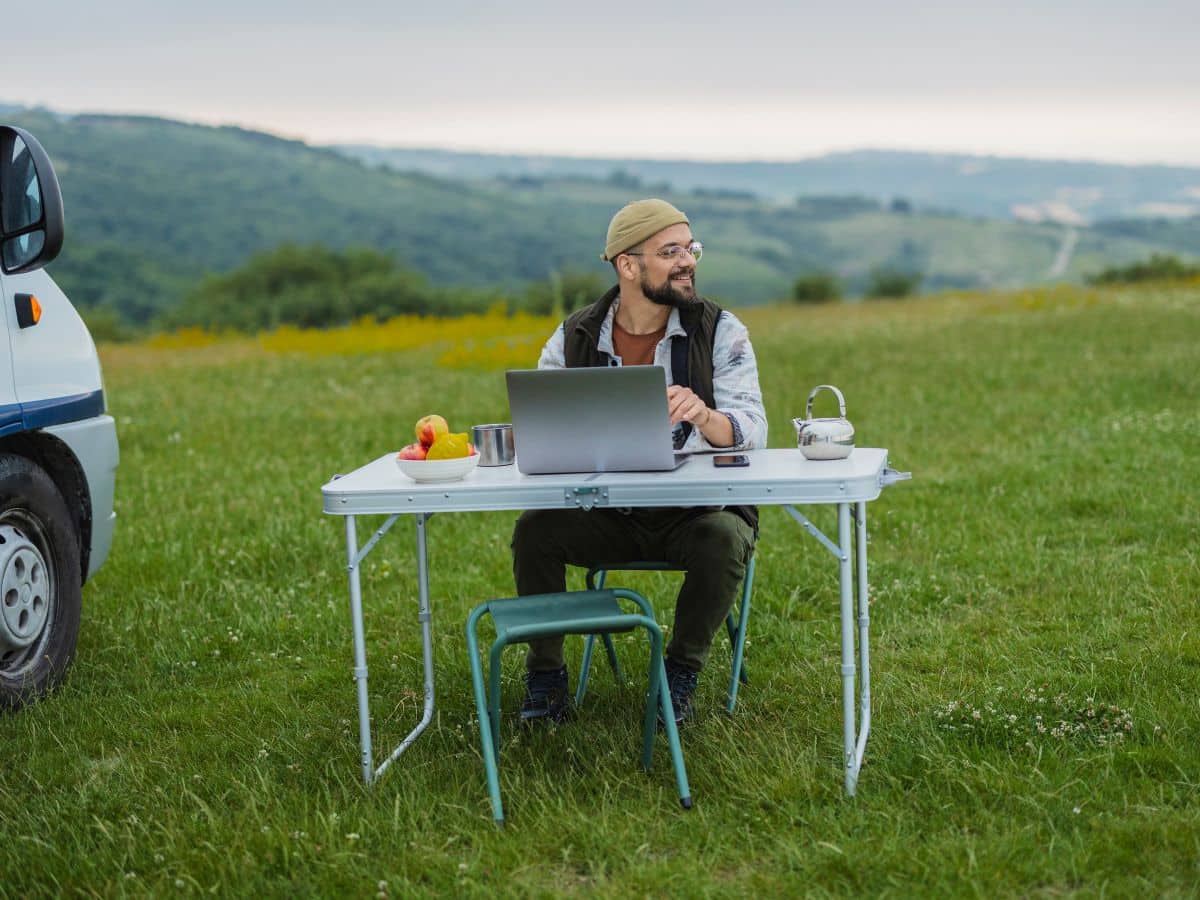
A laptop open on a wooden table, a quiet campsite in the background, maybe a coffee within reach, and just enough signal to stay connected without it ever becoming a problem. Work gets done efficiently, the air feels fresher than it does at home, and at the end of the day you simply close the laptop and step straight into the outdoors as if the whole thing has been designed that way from the start.
It’s a nice image, but it’s also (in most cases) slightly optimistic.
Camping while working remotely is absolutely possible, and with the right setup it can be genuinely enjoyable, but it rarely looks quite like that. The reality tends to sit somewhere between convenience and compromise, where things mostly work, occasionally don’t, and require just enough adjustment to keep you from losing your mind.
Signal drops at inconvenient times, power becomes something you think about more than you expected, and weather, which is normally just part of the experience, suddenly has a say in whether your “office” is usable at all. And small things, like where you sit or how long you can comfortably work for, start to matter in ways they never really did before.
Of course, none of this makes it a bad idea. And in fact, for most people, that slight shift away from everything being perfectly controlled is part of the appeal. Work feels a bit less rigid, the day has more variation to it, and there’s something genuinely satisfying about making it all function in an environment that wasn’t really designed for it.
But it does mean the approach needs to be slightly different.
Trying to recreate your normal working setup outdoors usually leads to frustration, because camping isn’t built around stability, it’s built around adaptability. The people who tend to make it work aren’t those with the most impressive setup, it’s often those who adjust their expectations just enough to meet the environment halfway.
And once that clicks, it becomes a lot easier to see what actually works, what doesn’t, and where the balance really sits between the two.
Quick Answer: Can You Work While Camping?
Camping while working remotely is possible, but it depends heavily on reliable internet, consistent power, and realistic expectations. Instead of trying to recreate a home office outdoors, the key is adapting your setup and workflow to suit a less predictable environment, because once you do that, it becomes far more manageable than it first appears.
Contents
- Internet: The Thing That Makes or Breaks Everything
- Power: Keeping Your Setup Alive
- Creating a Workspace That Doesn’t Drive You Mad
- Choosing the Right Campsites (This Matters More Than Gear)
- Balancing Work and Actually Enjoying Being Outdoors
- Camping While Working | Is It Actually Worth It? (Honest Pros and Cons)
- Frequently Asked Questions
- Final Thought
Internet: The Thing That Makes or Breaks Everything
If there’s one thing that will absolutely determine whether camping while working remotely feels smooth or incredibly stressful, it’s your internet connection.
Everything else (power, comfort, even weather to an extent) can usually be worked around with a bit of planning. But if your connection isn’t reliable, or at least predictable, it has a way of creeping into everything you do.
Calls become slightly tense, deadlines feel closer than they are, and even simple tasks take longer than they should because you’re never entirely sure whether things are going to hold up.
And the tricky part is that signal doesn’t always behave in a way that makes much sense.
You can be in what looks like an ideal location (open space, no obvious obstructions) and still struggle to get a stable connection. Then you move a few hundred metres down the road and suddenly everything works perfectly. It’s one of those things you don’t fully appreciate until you start relying on it.
Which is why choosing where you camp matters more than most people expect.
Before heading out, it’s worth checking coverage properly rather than assuming it’ll be fine. Tools like the Ofcom mobile coverage checker give you a realistic idea of what to expect in a specific area, which can save a surprising amount of frustration later on.
Even then, it’s not an exact science.
That’s why most people who do this regularly build in a bit of flexibility. If signal is critical, it helps to have options, different networks, a backup hotspot, or at the very least a nearby location you can move to if things aren’t working.
This is also where campsite choice becomes more important than gear.
A well-located campsite with decent coverage will almost always outperform a perfect setup in a location where signal is unreliable. It’s one of those trade-offs that becomes obvious fairly quickly, especially once you’ve had to relocate mid-task or hunt for a better connection when you’d rather just be working.
If you’re still figuring out where to stay, it’s worth thinking about campsites slightly differently than you normally would. Instead of focusing purely on scenery or seclusion, you’re also looking at practicality, access, layout, and how well it supports what you’re trying to do. That balance is something people tend to refine over time, particularly once they realise that the “perfect” spot on paper doesn’t always translate into a workable setup in reality, which is exactly why taking a bit of time to think about how to choose a campsite that actually suits your needs makes such a difference.
There’s also a broader point here about expectations.
Even with good coverage, things won’t always be as stable as they are at home, and that’s fine. The goal isn’t perfection, it’s reliability most of the time. Once you shift into that mindset, small interruptions stop feeling like problems and start feeling like part of the setup.
And that, more than anything, is what keeps it manageable.
Power: Keeping Your Setup Alive
Once you’ve got a handle on your internet, the next thing that becomes part of your daily awareness is power.
At home, it’s something you never really think about. You plug things in, they charge, and that’s the end of it. When you’re camping while working, it turns into something you keep half an eye on all the time.
Because everything you’re doing depends on it.
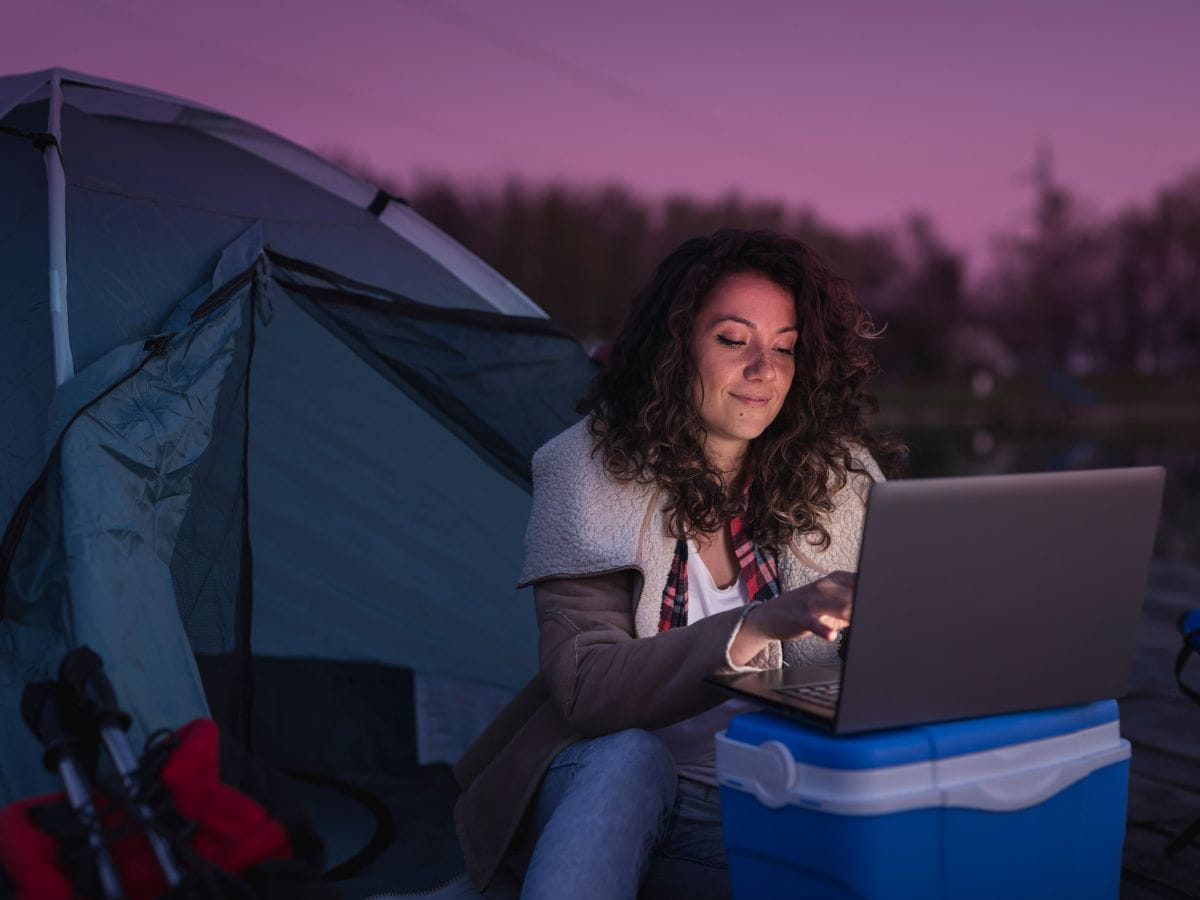
Your laptop, your phone, your hotspot, possibly headphones, maybe a light source if you’re working later in the day. It all adds up, and once you’re off-grid, or even just slightly removed from easy access to power, it becomes something you need to manage rather than assume.
That doesn’t mean it’s complicated, but it does mean it’s worth thinking about properly before you go.
For most setups, a good power bank is enough to cover the basics. Something with enough capacity to recharge your phone multiple times and give your laptop at least one decent top-up will usually carry you through a day without much trouble. If you’re only working in shorter bursts, you can often stretch that even further.
Where people tend to run into problems is underestimating how quickly things drain.
Working off a laptop outdoors, especially if you’re tethering or using data, can eat through battery faster than you expect. Add in charging your phone at the same time, and suddenly you’re a lot closer to empty than you thought you were.
That’s why it helps to build in a bit of buffer.
Having more capacity than you think you need, or a backup option, takes the pressure off completely. You’re no longer watching battery percentages or adjusting your work around what’s left, you’re just getting on with things.
This is also where your style of camping makes a difference.
If you’re staying on campsites with facilities, power becomes much easier to manage. Hookups, shared charging points, or even just access to somewhere you can plug in for an hour or two changes the whole dynamic. You’re effectively topping up as you go rather than relying entirely on what you brought with you.
If you’re camping off-grid, it’s a slightly different approach.
You’re relying more on what you carry, which means balancing capacity against weight and space. This is where people often start refining their setup over time, realising that having the right gear matters more than having lots of it, and that carrying slightly less only really works if the essentials are doing their job properly. This is something that tends to become clearer once you’ve got a bit of experience with how your kit actually performs in real conditions, rather than how it looks on paper.
It’s also why people gradually move towards setups that feel a bit more intentional.
Not complicated, and not overly technical, just a collection of things that work reliably together. A decent power bank, the right cables, maybe a simple charging routine that fits around your day. Nothing dramatic, but enough to make the whole thing feel stable.
Because that’s really the goal. You’re not trying to build a perfect off-grid office, you’re just making sure that power isn’t the thing that interrupts your flow every couple of hours.
Creating a Workspace That Doesn’t Drive You Mad
This is the part most people don’t really think about until they’re already there, slightly hunched over a laptop, shifting around in a camping chair and wondering why everything suddenly feels a bit harder than it should.
At home, your workspace is something you barely notice because it just works. The chair’s roughly right, the desk is at the right height, the lighting is consistent, and you can sit there for a few hours without thinking too much about it.
Outdoors, none of that is guaranteed.
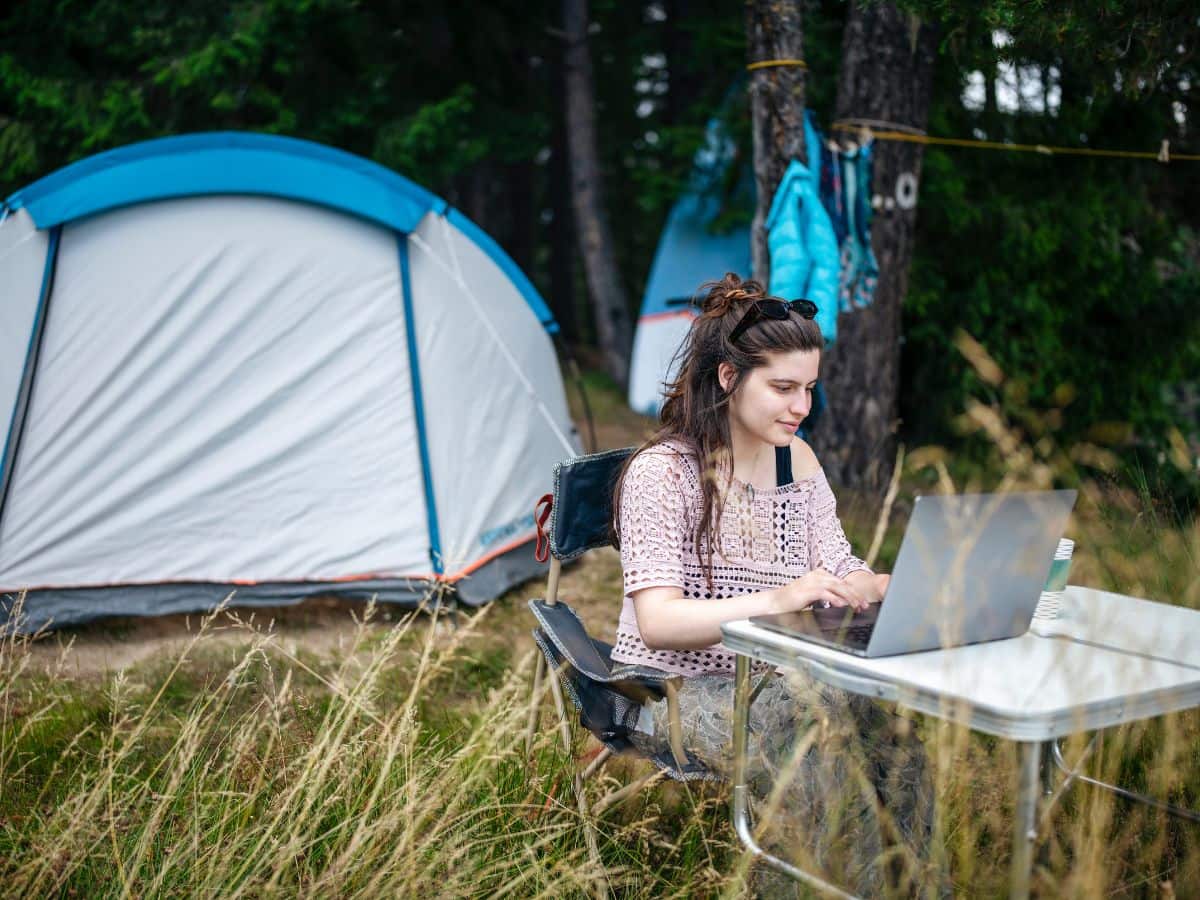
You might be working from a low table, or your lap, or whatever surface happens to be available. The light changes throughout the day. The ground isn’t always level. And something as simple as posture, which you’d normally ignore completely, starts to matter quite quickly once you’ve been sitting in the same position for a while.
It’s not dramatic, but it builds.
A slightly awkward setup for an hour is fine. A slightly awkward setup for three or four hours starts to show up in your back, your shoulders, and your general ability to focus on what you’re actually supposed to be doing.
Which is why comfort, again, becomes more important than people expect.
Having somewhere you can sit properly makes a huge difference. A decent chair, something that supports you rather than just existing beneath you, turns working from a campsite from something you tolerate into something that actually feels comfortable. It’s one of those things that seems like a small upgrade until you’ve tried both versions, at which point the difference becomes fairly obvious.
If you’ve ever dealt with any kind of back discomfort, this matters even more.
Sitting for long periods in a setup that isn’t quite right can bring that back (pun intended) fairly quickly, especially if you’re combining it with uneven ground or a lack of proper support. That’s why a lot of people end up paying far more attention to their seating and sleeping setup once they start spending longer periods outdoors, because the two are closely linked. If your sleep isn’t great and your daytime setup isn’t comfortable, it doesn’t take long before everything starts to feel a bit off. Which is exactly why things like having the right support, both when you’re working and when you’re resting, tend to make such a noticeable difference over the course of a few days.
The environment plays a role as well.
Wind, temperature, and even small distractions can affect how easy it is to settle into work. A slightly breezy day can make it harder to focus than you’d expect, and glare on your screen can turn a simple task into something unnecessarily frustrating.
This is where a bit of flexibility helps.
Instead of trying to force one fixed “workspace,” it’s often easier to adjust as you go. Move into the shade when the sun shifts, find a more sheltered spot if the wind picks up, or take advantage of a campsite table if one’s available. It’s less about creating the perfect setup and more about working with what’s there.
And again, this is where expectations come into play.
You’re not going to get the same level of comfort and consistency you have at home, and that’s fine. The goal is simply to make it good enough that you can work without constantly noticing the setup itself.
Once you reach that point, it tends to fade into the background. And when it does, you’re left with something that feels a lot more workable, even if it’s still slightly improvised around the edges.
Choosing the Right Campsites (This Matters More Than Gear)
One of the easiest mistakes to make when planning a trip like this is focusing too much on gear and not enough on where you’re actually going to stay.
It’s understandable. Gear feels like something you can control. You can research it, compare options, upgrade it over time. Location, on the other hand, tends to get treated as more of a backdrop, somewhere that looks nice, feels quiet, and ticks the usual boxes.
But when you’re camping while working, location stops being background and becomes part of the setup itself.
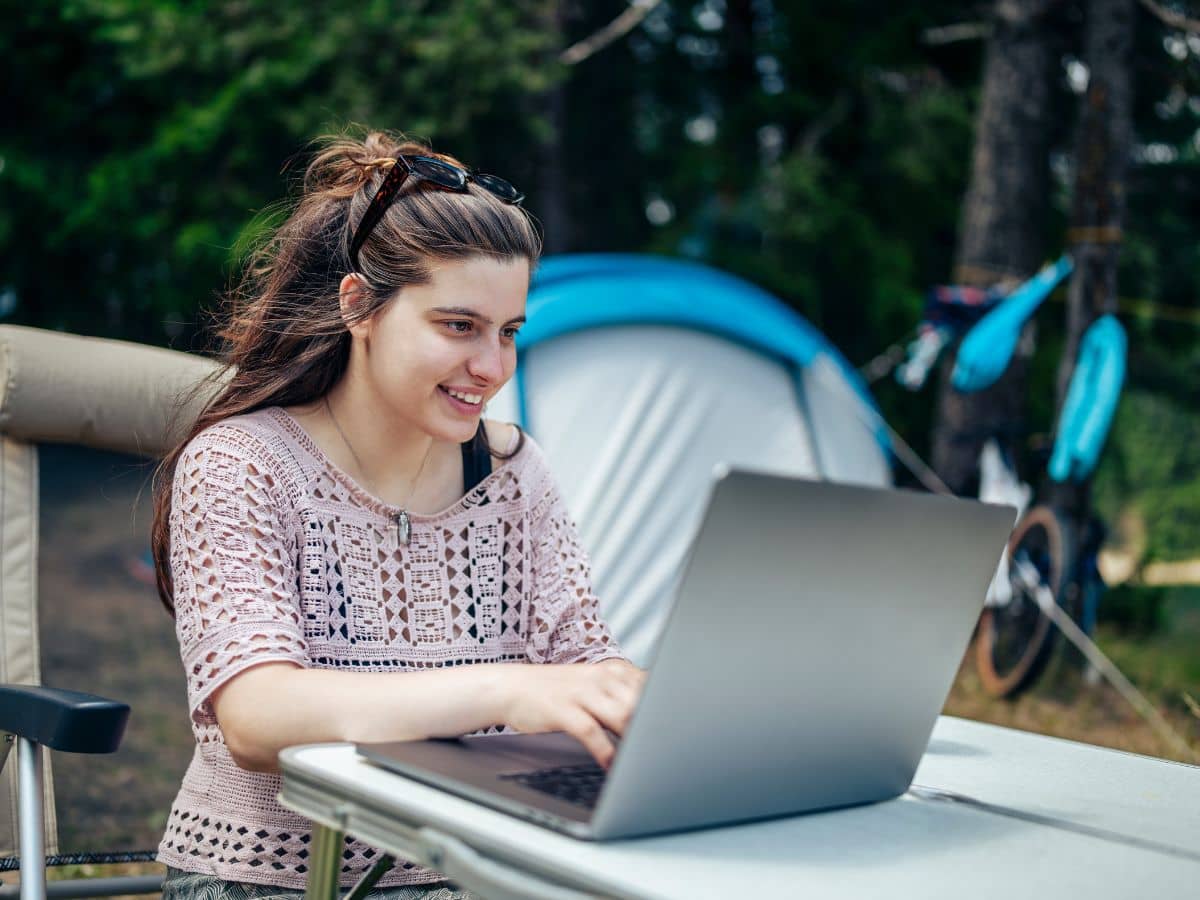
Because everything we’ve talked about so far, internet, power, comfort, all of it is influenced by where you are.
A campsite with decent mobile coverage, access to facilities, and a bit of shelter from the elements will make working feel relatively straightforward. The same setup in a more remote or exposed location can feel like hard work surprisingly quickly, even if the surroundings are objectively better.
That’s why it helps to shift your thinking slightly.
Instead of asking “where would be a nice place to camp?”, you start asking “where would actually work for what I need to do?” And those two answers don’t always line up perfectly.
It doesn’t mean you need to sacrifice the experience entirely; it just means finding a balance.
Some trips lean more towards comfort and reliability – campsites with good access, predictable conditions, and fewer variables to manage. Others lean more towards seclusion and simplicity, where you accept a bit more uncertainty in exchange for a quieter, more remote setting.
Both can work, but they feel very different when you’re trying to get work done at the same time.
If you’re still figuring out what suits you, it’s usually worth starting somewhere slightly easier.
A well-equipped campsite gives you a bit of breathing room while you dial in your setup. You can test your internet, figure out your power usage, and get a feel for how your working day fits into the environment without everything happening at once. It’s the same reason people tend to refine their approach over time rather than trying to get everything perfect from the start, because what works on paper doesn’t always translate cleanly into reality, which is exactly why taking the time to think about how to choose a campsite that actually fits what you’re trying to do makes such a difference once you’re out there.
As you get more comfortable, you can start experimenting.
More remote spots, different types of camping, even options like going without a traditional tent setup altogether if it suits your style. Some people gradually move towards simpler setups over time, not because they have to, but because they’ve worked out what they actually need and what they don’t, which is often very different from what they started with.
There’s also a practical side to this, especially in the UK.
Where you can camp, and how freely you can move between locations, isn’t always straightforward. Some areas are more relaxed (camping in Scotland for example), others are much stricter (pretty much everywhere else in the UK), and understanding that before you arrive avoids a lot of unnecessary hassle. It’s one of those things that people tend to learn as they go, usually after a slightly awkward conversation or a change of plans, which is why having a rough idea of where you can camp, how permissions work, and what’s generally accepted makes everything run a lot more smoothly.
And then there’s the simple reality that not every “perfect” location works for work.
Some places are too exposed, too busy, or just not set up in a way that makes it easy to settle in for a few hours. Others, which might not look quite as impressive at first glance, end up being far more practical once you’re there.
That’s something you only really figure out through experience.
But once you do, it becomes clear fairly quickly that the right location does more for your overall setup than any single piece of gear ever could.
Balancing Work and Actually Enjoying Being Outdoors
This is the part that tends to sneak up on people.
You go into it thinking the challenge will be the setup, internet, power, finding somewhere comfortable to sit, and while those things do matter, most of them can be solved with a bit of planning and a few adjustments.
What’s harder to manage is the balance between working and actually being there.
Because it’s surprisingly easy to recreate your normal working routine in a slightly nicer location without really changing how your day feels. You open the laptop, get stuck into what you need to do, move from one task to the next, and before you know it, the day’s gone and you’ve barely noticed where you are.
Which rather defeats the point.
At the same time, going too far in the other direction doesn’t work either.
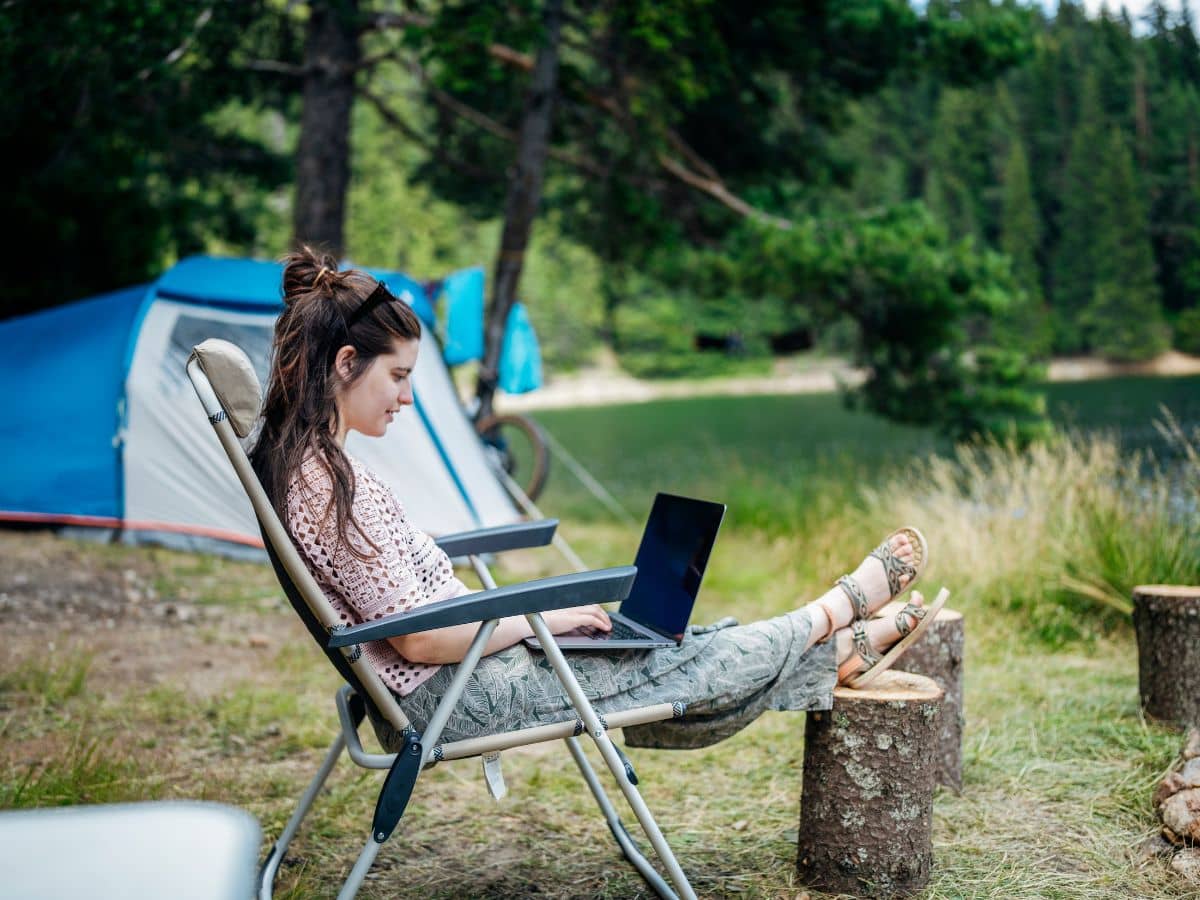
Trying to treat it like a holiday while still keeping up with work can leave you feeling slightly behind on both fronts, never quite fully focused, and never quite fully switched off. That’s where it starts to feel a bit messy, like you’re constantly catching up with yourself.
The balance tends to sit somewhere in the middle.
You’re still working, but you’re not trying to replicate a full office day. You’re taking advantage of the flexibility that comes with remote work – shorter bursts of focused work, a bit more movement, and a slightly looser structure that fits around the environment rather than fighting against it.
That’s usually where it starts to feel different in a good way.
Instead of everything being squeezed into a rigid schedule, the day has a bit more shape to it. You might work for a couple of hours in the morning, step away for a walk or just to reset, then come back to it later when it makes sense. It’s not always perfectly efficient, but it often feels more sustainable.
And that’s where the mental side of it comes in.
Spending time outdoors, even while you’re still working, tends to have a subtle effect. Not dramatic, not instant, but noticeable over a few days. Things feel a bit less intense, your attention shifts slightly, and the usual background noise of day-to-day work quiets down just enough to give you a bit more breathing room. It’s something people often notice after the fact rather than during it, especially once they’re back in their normal environment and realise things feel slightly different.
There’s a reason this kind of setup appeals to so many people.
It’s not just about working from a different place, it’s about changing how the day feels without stepping away from work entirely. That mix of productivity and a slightly slower pace is what makes it interesting, even if it takes a bit of trial and error to get right.
There is, however, a more practical consideration that tends to get overlooked, and that’s whether or not your work actually allows for it.
For some people, it makes no difference at all. As long as the work gets done and you’re available when you need to be, where you are doesn’t really come into it. For others, particularly in roles that involve regular meetings, secure systems, or more structured hours, it can be a bit more complicated.
That doesn’t mean it’s off the table.
It just means being realistic about what’s expected of you and making sure your setup can support that. If you’re relying on a stable connection for calls, for example, that needs to be factored into where you stay and how you plan your day. If your work is more flexible, you’ve got a bit more room to adapt things around the environment.
Either way, it’s worth thinking about in advance rather than trying to figure it out halfway through.
Because when everything lines up (when the work feels manageable, the setup is working, and you’ve found a rhythm that suits you) it tends to feel like something you’d happily do again.
Not perfectly, not all the time, but enough to make it worthwhile.
Camping While Working | Is It Actually Worth It? (Honest Pros and Cons)
This is usually the point where people step back slightly and ask whether it’s all worth the effort.
Because by now, it’s clear that camping while working remotely isn’t just a case of picking a nice spot and carrying on as normal. There’s a bit more to it than that. A few extra things to think about, a few small compromises, and the occasional moment where things don’t go quite as smoothly as you’d like.
So the question becomes less about whether it’s possible, and more about whether it’s actually worth doing.
And the honest answer is, it depends on what you’re expecting from it.
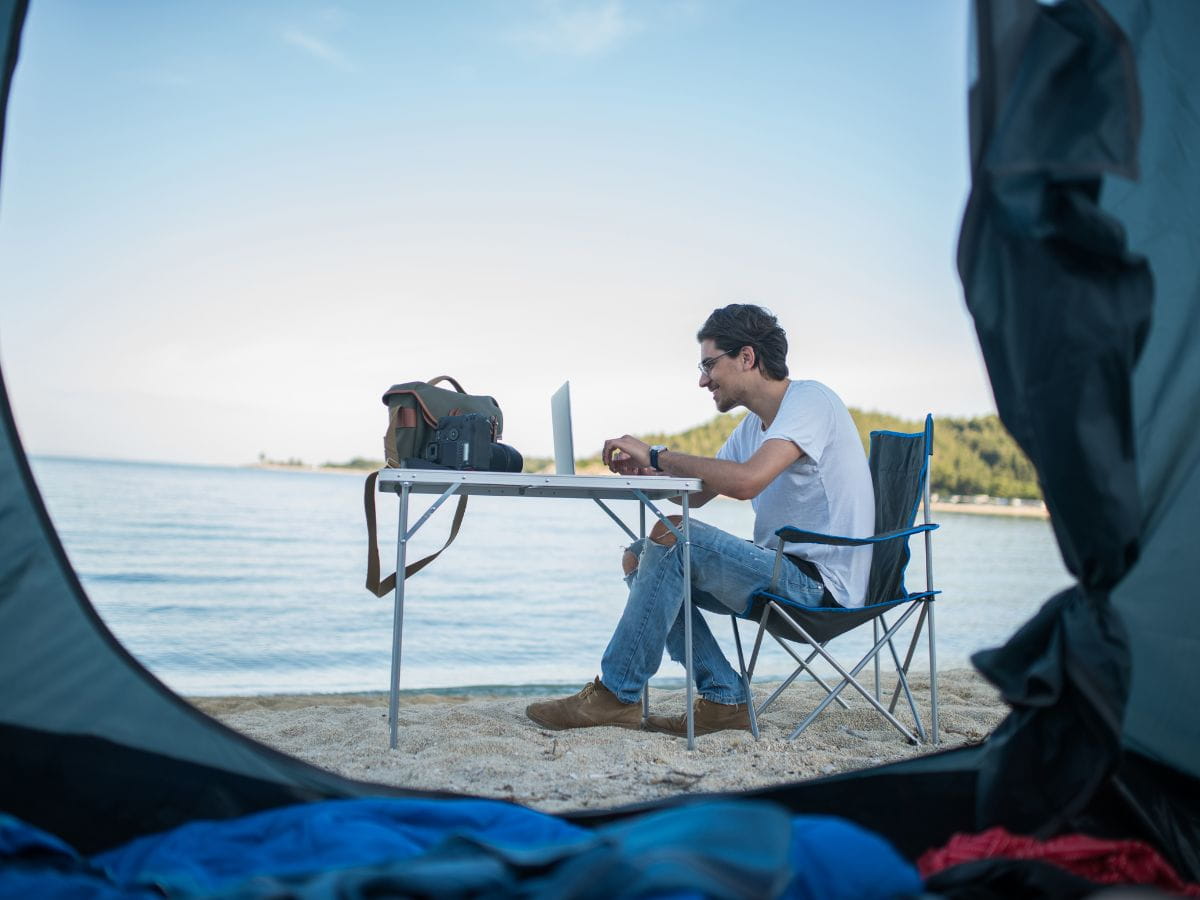
If you’re looking for a seamless replacement for your usual working environment, something that feels just as efficient, just as comfortable, and just as predictable, then it can feel slightly frustrating. There are too many variables for it to ever be completely smooth, and trying to force it into that shape usually leads to disappointment.
But if you’re open to something that works a bit differently, then the picture changes.
Because while it might not be perfect, it offers something your normal setup doesn’t.
There’s a noticeable shift in how the day feels. Even when you’re working, there’s a bit more space around it. You’re not boxed into the same routine, not looking at the same walls, and not moving through the same pattern from morning to evening without much variation. And that alone can be enough to make it worthwhile.
There’s also a certain level of flexibility that comes with it.
You can structure your day in a way that suits both your work and your surroundings. Work when it makes sense, step away when you can, and let the environment influence the rhythm of the day rather than trying to control it completely.
It’s not always the most efficient way to work, but it can be one of the more enjoyable ones.
But of course, there are trade-offs.
Things take a little more effort, and planning matters more. You need to think about signal, power, and where you’re going to stay in a way you normally wouldn’t. And every now and then, something won’t quite work, which is part of the deal.
But for a lot of people, those trade-offs are fairly easy to accept.
Because what you get in return isn’t just a different place to work, it’s a different way of working altogether. Something that feels a bit less fixed, a bit more adaptable, and occasionally far more enjoyable than you’d expect going into it.
It’s not something everyone would want to do all the time. But as an option, something you dip into when it suits you, or build into your routine in a way that works around your life, it can be surprisingly worthwhile.
And once you’ve found a version of it that fits, it tends to stick with you.
Frequently Asked Questions
Can you realistically work full-time while camping?
You can, but it depends heavily on the type of work you do and how flexible your setup is.
If your job relies on constant video calls, strict hours, or a very stable connection, it can feel slightly stressful unless everything is dialled in properly. On the other hand, if your work is more task-based, perhaps writing, design, or general online work, it tends to translate much more easily into a camping setup.
For most people, it works best as a hybrid approach.
You might work slightly shorter days, adjust your schedule, or build in a bit more flexibility rather than trying to mirror a full office routine exactly. That way, you’re not constantly fighting the environment.
What jobs are best suited to camping while working?
Roles that don’t rely on constant real-time communication tend to work best.
Writing, coding, design, marketing, and general freelance work are all relatively easy to adapt, because you can structure your time around when things are working well. Jobs that require stable, uninterrupted connectivity can still be done, but they usually need a more controlled setup and careful planning.
It’s less about the job itself and more about how much flexibility it allows.
How reliable is internet when camping in the UK?
It varies more than people expect.
Some campsites have surprisingly good coverage, especially those closer to towns or main roads, while more remote locations can be very patchy. It’s rarely as consistent as a home connection, which is why checking coverage in advance and having a backup plan makes such a difference.
If you’re planning something more off-grid, it’s worth understanding how different environments affect your setup, particularly when it comes to signal, power, and general logistics, because the further you move away from facilities, the more those small details start to matter in practice, which is something that tends to become clear fairly quickly once you’ve spent a bit of time doing it.
A lot of people start with more accessible locations and gradually move into more remote setups once they’ve worked out what’s actually needed, which is a much smoother way to approach it than jumping straight into the deep end, especially if you’re still figuring out how off-grid camping works in real terms.
Is camping while working stressful?
It can be, if you go into it expecting everything to run perfectly.
Most of the stress tends to come from trying to recreate a normal working environment in a setup that isn’t designed for it. Once you accept that things will work slightly differently, and plan around that, it becomes far more manageable.
In fact, for a lot of people, it ends up feeling less stressful overall.
Spending time outdoors has a subtle but noticeable effect on how your day feels, even when you’re still working. It’s not a cure-all, but it does tend to take the edge off things slightly, which is why there’s growing recognition of the link between time outside and mental wellbeing, something organisations like Mind.org highlight when discussing how being in natural environments can support stress reduction and overall mental health.
Do you need lots of gear to work while camping?
Not really.
Most people start off thinking they need a full setup, extra equipment, and a backup of everything, but in practice, it usually comes down to a few key things that work reliably. Internet, power, and a reasonably comfortable place to work will take you most of the way there.
Over time, people tend to simplify rather than add more.
Once you’ve done a few trips, you start to realise what actually gets used and what doesn’t, which is why many setups naturally move towards something a bit more streamlined and efficient rather than overly complicated, especially once you’ve had a chance to refine your approach and avoid some of the more common camping mistakes people make when they’re starting out.
Can you camp anywhere while working remotely?
Not quite, especially in the UK.
There are restrictions around where you can legally camp, particularly in England and Wales, and while there are ways to do it responsibly, it’s not as simple as just finding a spot and setting up.
If you’re planning to move around while working, it’s worth understanding the rules properly, including where wild camping is allowed, when you need permission, and what the potential consequences are if you get it wrong. It’s one of those areas that catches people out, usually because they assume it’s more relaxed than it actually is, which is why having a clear idea of where you can camp and how it works in practice makes things much easier to navigate once you’re out there.
Is camping while working expensive?
It doesn’t have to be.
There’s an upfront cost if you don’t already have the gear, but beyond that, it can be as affordable or as expensive as you make it. Campsite fees, food, travel, and equipment all play a role, but it’s entirely possible to keep things relatively low-cost with the right approach.
A lot of it comes down to how you plan your trips and what level of comfort you’re aiming for. Some setups lean more towards convenience and facilities, others towards simplicity and lower costs, and finding that balance is usually what determines how expensive it feels overall, especially once you’ve got a clearer idea of what you actually need rather than what you think you might need at the start.
Final Thought
Camping while working remotely isn’t quite the effortless lifestyle it sometimes gets made out to be, and in a way, that’s part of what makes it work.
It asks a bit more of you.
A bit more planning, a bit more awareness, and a willingness to adapt when things don’t quite line up the way they would at home. Some days will feel smooth and straightforward, others slightly uneven, and most will sit somewhere in between without making a big deal of it.
But that’s also where the appeal tends to come from.
You’re not just changing your location, you’re changing the feel of your day. Work becomes something that fits around a different environment rather than something that dictates it completely, and even small shifts in that balance can make a noticeable difference over time.
It’s not about escaping work entirely, or turning every trip into some kind of idealised version of remote living. It’s about finding a version of it that actually works for you.
Something that’s practical enough to be sustainable, flexible enough to adapt, and enjoyable enough that you’d choose to do it again, even knowing it won’t be perfect.
And once you find that balance, even in a fairly simple, slightly improvised way, it tends to stick. Not because it replaces your normal routine, but because it offers something just different enough to make it worthwhile.
